The 4-Year Degree Is Getting an AI Makeover: Here’s What College Will Look Like by 2030
Share this on:


Find your perfect college degree
In this article, we will be covering...
For generations, the traditional four-year college degree followed a familiar formula: attend lectures, complete assignments, pass exams, and graduate with a diploma. While technology has gradually modernized classrooms, the basic structure of higher education has remained remarkably consistent.
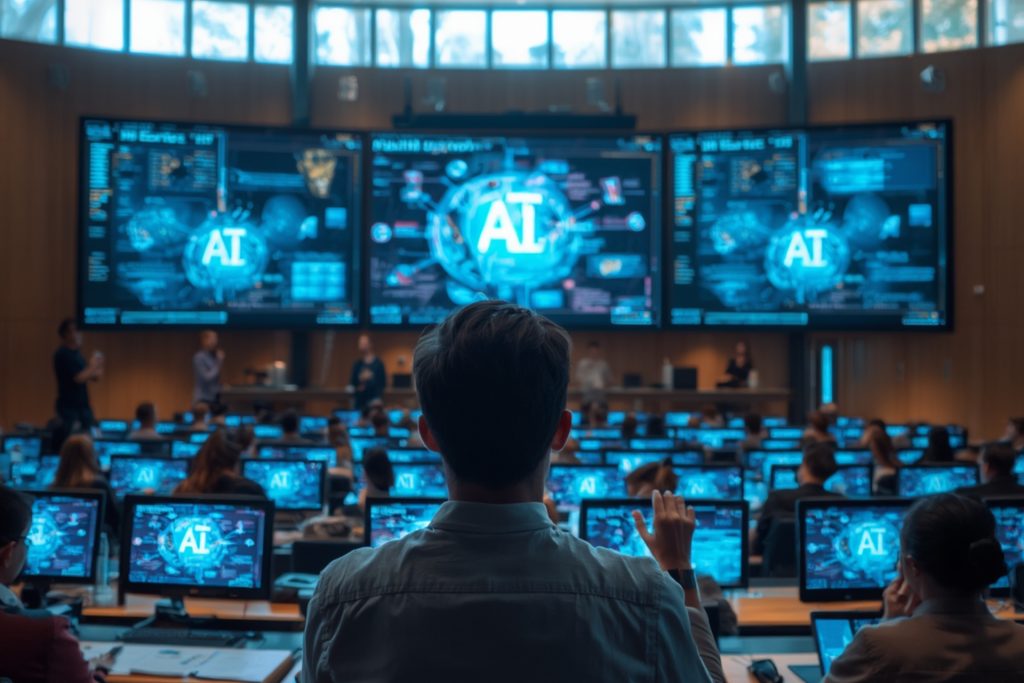
Artificial intelligence (AI), however, is accelerating a transformation unlike any colleges have experienced before. AI is changing how students learn, how professors teach, how institutions deliver support services, and how employers evaluate graduates. By 2030, earning a bachelor’s degree may look significantly different—not because the value of higher education has diminished, but because AI is reshaping nearly every aspect of the college experience.
The future is unlikely to be fully automated. Instead, colleges are expected to blend AI-powered tools with human instruction, creating more personalized, flexible, and career-focused learning environments.
Why Colleges Are Adopting AI So Quickly
Higher education faces several long-standing challenges:
- Rising tuition costs
- Student retention concerns
- Growing demand for workforce-ready graduates
- Faculty workload pressures
- Expanding online and hybrid learning
- Rapid technological change across industries
AI offers solutions that can help institutions improve efficiency while enhancing student success.
Rather than replacing educators, AI is increasingly being used to automate repetitive tasks, personalize instruction, provide instant academic support, and generate data-driven insights that help colleges better serve students.
What Will the Four-Year Degree Look Like by 2030?
Several emerging trends suggest how undergraduate education could evolve over the next few years.
1. Every Student May Have an AI Learning Assistant
Instead of relying solely on office hours or tutoring centers, students may work alongside AI assistants available 24/7.
These assistants could:
- Explain difficult concepts
- Generate personalized study guides
- Create practice quizzes
- Provide writing feedback
- Recommend supplemental resources
- Track learning progress
- Adapt explanations to different learning styles
Rather than replacing professors, AI tutors may reinforce classroom instruction by providing immediate support whenever students need it.
2. Personalized Degree Pathways Will Become the Norm
Traditional degree plans often follow rigid course sequences.
AI may allow colleges to customize academic pathways based on each student’s:
- Career goals
- Learning pace
- Academic strengths
- Prior knowledge
- Interests
- Internship experiences
- Skill development
Instead of every student completing identical assignments, coursework may become increasingly individualized while still meeting program outcomes.
3. Smarter Academic Advising
Academic advisors often manage hundreds of students.
AI can assist by identifying students who may need intervention before problems become serious.
Predictive systems may detect:
- Declining grades
- Missed assignments
- Attendance issues
- Financial risk
- Registration delays
- Graduation obstacles
Human advisors can then focus their attention where it matters most.
4. AI Will Transform Classroom Instruction
By 2030, lectures may become more interactive.
Faculty could use AI to:
- Generate real-world case studies
- Create adaptive quizzes
- Develop simulations
- Analyze student misconceptions
- Produce multimedia learning materials
- Personalize classroom activities
Students, meanwhile, may spend less time memorizing facts and more time applying knowledge through projects, collaboration, and problem-solving.
5. Assessments Will Shift Beyond Traditional Exams
Artificial intelligence makes it easier for students to generate essays and solve routine problems.
As a result, colleges are already reconsidering assessment strategies.
Future evaluations may emphasize:
- Oral presentations
- Research projects
- Team collaboration
- Portfolios
- Practical demonstrations
- Experiential learning
- Industry-sponsored challenges
The focus will increasingly move toward demonstrating understanding rather than simply recalling information.
Career Preparation Will Become More Integrated
Employers continue to emphasize practical skills alongside academic credentials.
AI can help colleges better connect coursework with workforce needs by:
- Matching students with internships
- Identifying emerging job skills
- Recommending certifications
- Suggesting extracurricular experiences
- Building digital portfolios
- Tracking competency development
Graduates may leave college with both a degree and a verified record of demonstrated skills.
AI-Powered Student Support Services
Student success extends beyond academics.
By 2030, AI may improve many campus services.
Financial Aid Guidance
AI chatbots could answer common questions about:
- FAFSA requirements
- Scholarships
- Loan repayment
- Deadlines
- Verification documents
Students may receive faster support outside normal office hours.
Mental Health Resources
While AI cannot replace licensed professionals, it may help students by:
- Providing wellness check-ins
- Recommending campus resources
- Offering stress-management exercises
- Identifying when students should seek human support
Responsible implementation will require careful attention to privacy and ethics.
Career Services
AI may provide personalized career coaching through:
- Resume feedback
- Interview practice
- Networking suggestions
- Labor market analysis
- Salary insights
- Job matching
Career preparation could begin much earlier in a student’s academic journey.
New Skills Every College Student Will Need
As AI becomes commonplace, employers are placing greater value on skills that complement technology rather than compete with it.
Students graduating in 2030 are likely to need strong abilities in:
- Critical thinking
- Ethical decision-making
- Communication
- Creativity
- Data literacy
- Digital collaboration
- AI literacy
- Information evaluation
- Leadership
- Adaptability
Knowing how to use AI effectively may become as fundamental as knowing how to use spreadsheets or presentation software today.

Will AI Replace Professors?
One of the most common concerns is whether AI will eliminate faculty roles.
The answer is likely no.
Effective teaching involves:
- Mentorship
- Research supervision
- Classroom discussion
- Emotional intelligence
- Ethical guidance
- Professional networking
- Subject-matter expertise
These human-centered responsibilities remain difficult for AI to replicate.
Instead, professors may spend less time on administrative tasks and more time engaging directly with students.
Challenges Colleges Must Address
The transition to AI-enhanced education also raises important concerns.
Academic Integrity
Institutions continue to develop policies governing responsible AI use while encouraging learning rather than misuse.
Equity of Access
Not all students have equal access to premium AI tools, reliable internet, or advanced devices.
Colleges must work to ensure that AI adoption does not widen existing educational inequities.
Data Privacy
AI systems often rely on large amounts of student data.
Institutions must protect personal information through transparent governance, secure technology, and compliance with privacy regulations.
Faculty Training
Successful AI integration depends on preparing instructors to use new technologies effectively and responsibly.
Professional development will remain essential.
Frequently Asked Questions
Will college degrees still matter in 2030?
Yes. While AI will change how students learn and demonstrate knowledge, bachelor’s degrees are expected to remain valuable credentials, especially when paired with practical skills, internships, and industry experience.
Will AI replace college classes?
No. AI is more likely to supplement classroom instruction through tutoring, personalized learning, and administrative support than replace professors or traditional courses.
What skills should college students develop for an AI-driven future?
Students should strengthen critical thinking, communication, ethical reasoning, creativity, digital literacy, collaboration, and AI literacy to remain competitive in evolving workplaces.
Will homework disappear because of AI?
Probably not. Instead, assignments are likely to evolve toward projects, presentations, portfolios, simulations, and authentic assessments that require deeper understanding and original thinking.
Should students learn how to use AI before college?
Yes. Familiarity with responsible AI use can help students transition more effectively into college, where AI-assisted learning tools are becoming increasingly common.
Preparing for the College Experience of 2030
Students entering college over the next few years will encounter a learning environment shaped by intelligent technologies, personalized support, and stronger connections between education and employment. Success will depend not only on mastering academic content but also on learning how to collaborate effectively with AI while exercising sound judgment and ethical decision-making.
Prospective students can prepare by building digital literacy, practicing responsible AI use, strengthening research and communication skills, and remaining adaptable as technology continues to evolve. Colleges that balance innovation with human mentorship will be best positioned to help graduates thrive in an AI-enabled workforce.
Final Thoughts
The four-year degree is not disappearing—it is evolving. By 2030, artificial intelligence is expected to make college education more personalized, interactive, and responsive to student needs while helping institutions improve advising, teaching, and career preparation. At the same time, the qualities that define an exceptional college education, such as curiosity, critical inquiry, collaboration, and mentorship, will remain deeply human.
For students, the future of higher education is not about choosing between AI and traditional learning. It is about learning to use AI as a powerful tool while developing the uniquely human skills that technology cannot replace.