Find your perfect college degree
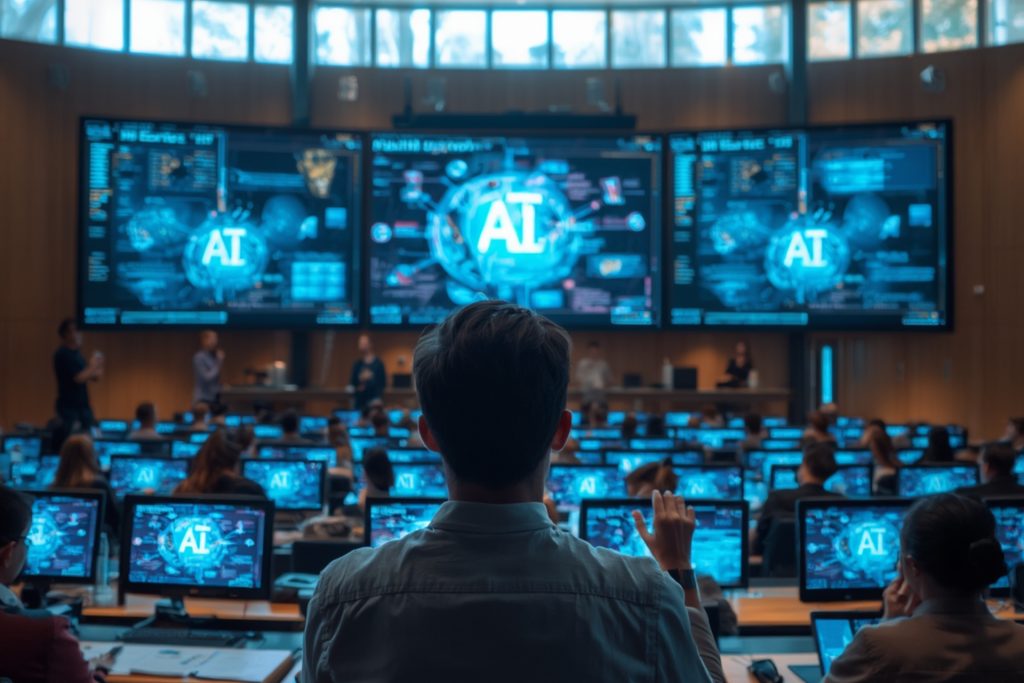
Artificial intelligence is already changing how colleges teach, research, advise, and support students. AI-powered tutors, writing assistants, predictive analytics, and administrative chatbots have become common across many campuses. Over the next decade, these technologies are expected to evolve from helpful tools into integrated systems that shape nearly every aspect of college life.
The college experience of 2036 will likely look very different from today’s. Students may learn through personalized AI tutors, receive real-time academic guidance, collaborate with intelligent research assistants, and navigate campuses enhanced by smart technologies. At the same time, colleges will continue grappling with questions about privacy, ethics, academic integrity, and equitable access.
While no one can predict the future with certainty, current trends provide a strong foundation for understanding how AI may redefine higher education.
Key Takeaways
- AI will likely personalize learning for every student.
- Traditional lectures may become more interactive and AI-assisted.
- Academic advising will become faster and more data-driven.
- Career preparation will increasingly emphasize AI literacy across all majors.
- Colleges will continue balancing AI innovation with academic integrity and ethical use.
- Human professors, mentors, and campus communities will remain central to the college experience.
Why AI Will Continue Transforming Higher Education
Higher education has always evolved alongside technology. Libraries digitized collections, online learning expanded access, and cloud computing enabled global collaboration. AI represents the next major shift because it can assist with decision-making, content creation, research, and individualized learning.
Rather than replacing universities, AI is expected to enhance many existing educational practices while creating entirely new ways for students to learn and engage.
1. Every Student Could Have a Personal AI Learning Coach
One of the biggest changes may be the rise of always-available AI learning assistants.
Instead of searching through textbooks or waiting for office hours, students could receive personalized explanations tailored to their learning style and academic background.
Future AI tutors may:
- Explain difficult concepts in multiple ways.
- Generate customized practice quizzes.
- Identify knowledge gaps.
- Recommend additional learning resources.
- Translate complex material into simpler language.
- Adjust instruction based on individual progress.
Students who struggle with certain subjects may receive additional support without the stigma sometimes associated with tutoring.
2. College Classes May Become More Personalized
Today’s courses often follow a single syllabus for every student.
In the future, AI could personalize portions of coursework while maintaining common learning objectives.
Examples include:
- adaptive reading assignments
- customized problem sets
- individualized study schedules
- personalized review sessions
- AI-generated practice exams
- targeted feedback after assessments
Professors would still determine learning outcomes while AI helps students reach them through different pathways.
3. Professors Will Spend More Time Teaching and Less Time Grading
Faculty workloads include many repetitive administrative tasks.
AI may increasingly assist with:
- grading objective assessments
- organizing course materials
- identifying students needing additional support
- generating practice exercises
- summarizing classroom discussions
- answering frequently asked course questions
This could allow professors to devote more time to mentoring, discussion, research supervision, and project-based learning.
Importantly, subjective work such as essays, capstone projects, and research papers will still benefit from human evaluation and feedback.
4. Academic Advising Will Become Smarter
Instead of scheduling advising appointments weeks in advance, students may receive continuous AI-powered guidance.
Future advising systems could help students:
- Select courses.
- Monitor graduation progress.
- Estimate graduation timelines.
- Identify scholarship opportunities.
- Plan internships.
- Compare career pathways.
- Receive transfer-credit evaluations.
Human advisors would continue providing personal guidance for complex academic and life decisions.
5. Career Preparation Will Start Earlier
AI will likely connect academic planning with career development much sooner.
Students may receive personalized recommendations based on:
- interests
- completed coursework
- labor market trends
- internship availability
- emerging industries
- desired salary ranges
- regional employment demand
Career centers may use AI simulations to prepare students for interviews, workplace scenarios, and professional communication.
6. Research Will Become More Collaborative
College students increasingly participate in undergraduate research.
Future AI research assistants may help students:
- Summarize scholarly articles.
- Identify research gaps.
- Organize citations.
- Analyze datasets.
- Generate programming code.
- Visualize findings.
- Manage research workflows.
Students will still need to critically evaluate AI-generated information and maintain academic integrity throughout the research process.
7. Smart Campuses Will Improve Student Life
AI’s influence will extend beyond the classroom.
Smart campus technologies may optimize:
- classroom scheduling
- parking availability
- dining hall traffic
- campus transportation
- energy consumption
- facility maintenance
- residence hall management
- emergency notifications
These systems could improve operational efficiency while creating more convenient campus experiences.
8. AI Could Expand Accessibility
One of AI’s greatest opportunities lies in improving accessibility for diverse learners.
Potential applications include:
- real-time captioning
- speech-to-text services
- language translation
- personalized reading support
- adaptive interfaces
- visual assistance technologies
- automated note-taking
- accessibility recommendations
These innovations may help reduce barriers for students with disabilities and multilingual learners.
9. AI Literacy Will Become a Core College Skill
Just as digital literacy became essential over the past two decades, AI literacy is likely to become a foundational competency.
Students across every major may learn how to:
- Write effective AI prompts.
- Verify AI-generated information.
- Recognize AI bias.
- Protect personal data.
- Cite AI appropriately.
- Understand ethical AI use.
- Collaborate responsibly with AI tools.
Employers increasingly value graduates who know how to use AI thoughtfully rather than relying on it uncritically.
10. Degrees May Become More Flexible
AI could support more personalized educational pathways.
Instead of following rigid degree plans, students may combine:
- traditional courses
- industry certifications
- competency-based assessments
- project portfolios
- internships
- microcredentials
- online modules
AI systems could help verify learning outcomes and recommend the next steps toward graduation.
Challenges Colleges Will Need to Address
While AI offers many opportunities, institutions will continue facing important challenges.
Academic Integrity
Universities must distinguish between responsible AI assistance and dishonest academic work while establishing clear classroom policies.
Student Privacy
AI systems process large amounts of educational data, making privacy and cybersecurity ongoing priorities.
Equity and Access
Not every student has equal access to premium AI tools or reliable internet connections. Colleges will need strategies to reduce technology gaps.
Faculty Training
Instructors will require ongoing professional development to integrate AI effectively into teaching and assessment.
Ethical Decision-Making
Students must learn when AI should, and should not, be used in academic and professional settings.
Skills Future College Students Should Develop
To thrive in an AI-enhanced educational environment, students should strengthen both technical and human-centered skills.
Technical Skills
- AI literacy
- data interpretation
- digital research
- information evaluation
- cybersecurity awareness
- technology adaptability
Human Skills
- critical thinking
- creativity
- ethical reasoning
- communication
- leadership
- collaboration
- emotional intelligence
- problem-solving
These uniquely human abilities will remain valuable even as AI becomes more capable.
Frequently Asked Questions
Will AI replace college professors?
No. AI is expected to assist professors with administrative tasks, personalized learning support, and course preparation, while instructors continue providing mentorship, expertise, discussion, and evaluation.
Will every college student use AI?
AI use will likely become increasingly common across most majors, although adoption will vary by institution, discipline, and instructor policies.
Will college degrees still matter?
Yes. Degrees are expected to remain valuable because they demonstrate subject knowledge, critical thinking, communication skills, and sustained academic achievement. AI may change how students learn, but it does not eliminate the value of higher education.
What careers will benefit most from AI skills?
Nearly every field, including healthcare, business, engineering, education, law, communications, finance, and the arts, is expected to incorporate AI tools into daily work. Graduates who can use AI responsibly alongside strong domain expertise may have a competitive advantage.
Should students learn AI now?
Yes. Developing AI literacy now can help students use these tools effectively, understand their limitations, and prepare for workplaces where AI is increasingly integrated into everyday tasks.
Final Thoughts
The college experience a decade from now will likely be more personalized, data-informed, and technologically connected than ever before. AI has the potential to improve learning, expand accessibility, strengthen career preparation, and streamline campus operations. Yet the most successful colleges will be those that combine technological innovation with the enduring strengths of higher education: expert faculty, meaningful mentorship, collaborative learning, ethical inquiry, and vibrant campus communities.
Rather than replacing the traditional college experience, AI is poised to reshape it. Students who embrace AI as a tool, while continuing to cultivate critical thinking, creativity, and interpersonal skills, will be well-positioned to succeed in the future of higher education and the evolving workforce.