Which U.S. Colleges Have the Most Progressive AI Curricula?
Share this on:


Find your perfect college degree
From the nation’s first AI bachelor’s degree to brand-new 2026 launches — here’s how leading universities are building the next generation of AI talent.
Quick Answer
The U.S. colleges with the most progressive AI curricula in 2026 are Carnegie Mellon University (ranked #1 globally, home to the nation’s first AI bachelor’s degree since 2018), MIT, Stanford University, UC Berkeley, and Northwestern University (launching a new AI major in Fall 2026). The University of Wisconsin–Madison has also created an entirely new College of Computing and Artificial Intelligence, effective July 2026.
Why AI Curricula Are Being Redesigned Right Now
Artificial intelligence is no longer a sub-topic in a computer science elective. It is reshaping how American universities organize departments, attract funding, and define what a degree is for. The numbers tell the story fast:
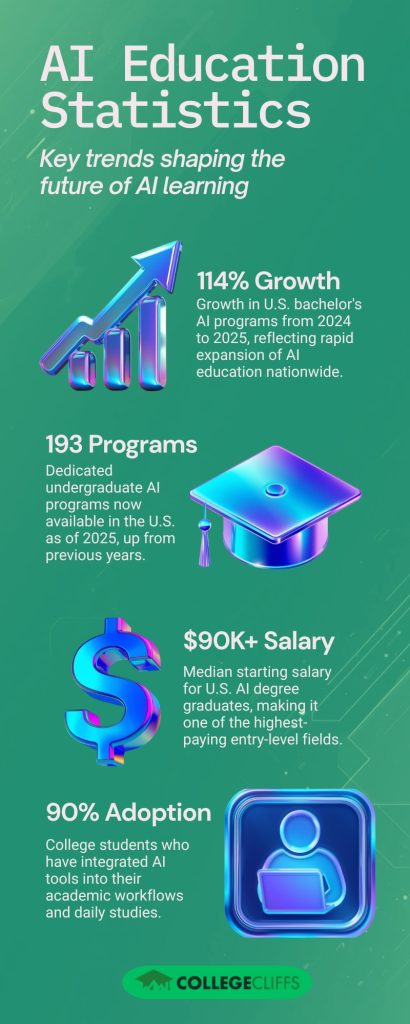
- 114% Growth in U.S. bachelor’s AI programs from 2024 to 2025
- 193 Dedicated undergraduate AI programs in the U.S. as of 2025
- $90K+ Median starting salary for U.S. AI degree graduates
- 90% College students who have integrated AI into their academic workflows
Despite that near-universal adoption, only 51% of recent graduates felt they had sufficient AI skills for the jobs they applied to, according to the Cengage 2025 Graduate Employability Report. The gap between what students are doing with AI and what institutions are formally teaching them is exactly what the most progressive campuses are racing to close.
What makes a curriculum “progressive” for this breakdown? We looked at institutions that have launched standalone AI degree programs, restructured entire colleges around AI, embedded AI literacy across non-technical disciplines, or established campus-wide AI governance frameworks — not just added a ChatGPT module to an existing course.
Campus-by-Campus Breakdown
#1 Ranked · Pioneer
Carnegie Mellon University
Pittsburgh, Pennsylvania
First AI B.S. in U.S. 25+ AI Programs Gen AI Certificate MS AI & Innovation
CMU has been the defining institution in American AI education since the field itself was created. In 2018, its School of Computer Science launched the nation’s first bachelor’s degree in Artificial Intelligence — a move that set the benchmark every other university is now chasing. Today, CMU offers over 25 programs at all levels surrounding AI, from undergraduate concentrations to doctoral research tracks and a graduate certificate in Generative AI.
Its flagship MS in Artificial Intelligence and Innovation grounds students in machine learning, neural networks, natural language processing, and deep learning while adding a business layer: market intelligence, intrapreneurship, and entrepreneurship. The MS in AI Engineering (MS AIE) bridges AI with traditional engineering disciplines, producing graduates ready for roles as data scientists, neuroengineers, and deep learning research engineers.
CMU’s AI program is ranked #1 in the world by U.S. News & World Report for 2025.
Co-Leader · Research Powerhouse
Massachusetts Institute of Technology (MIT)
Cambridge, Massachusetts
Deep Learning Research Reinforcement Learning AI Ethics Integration Cross-disciplinary
MIT shares the top spot with CMU in the 2026 U.S. News AI rankings. Its AI curriculum is distinctive for its emphasis on advanced deep learning algorithms and reinforcement learning, supported by cutting-edge research projects that frequently set the global agenda. Where CMU leans into applied engineering, MIT blends rigorous theory with cross-disciplinary research — AI intersecting with biology, climate science, economics, and policy.
MIT’s approach to AI ethics is woven into the curriculum rather than siloed as a single elective. Students engage with questions of bias, fairness, and accountability throughout their core coursework, reflecting an institutional commitment to responsible deployment alongside technical mastery.
MIT’s free, openly published course materials give the world access to the same curriculum used to train researchers at one of the field’s most influential institutions.
Top 3 · Industry Bridge
Stanford University
Stanford, California
NLP Leadership Computer Vision Robotics RLHF Specialization
Stanford’s AI master’s program is recognized for deeply integrating machine learning with practical, high-demand applications: natural language processing, computer vision, and robotics. Its CS224N (NLP with Deep Learning) course is widely regarded as one of the most influential AI courses in the world — student projects from the course have been published in conference proceedings, and the course has produced practitioners now working on LLMs at leading AI labs.
Stanford’s proximity to Silicon Valley gives it a structural advantage: industry partnerships, guest lecturers who are also active practitioners, and a direct pipeline into the companies building the tools students are studying. Graduates with machine learning specializations from Stanford report starting salaries approximately 40% higher than peers from comparable programs.
Stanford openly publishes its complete AI course materials, including CS224N and its reinforcement learning curriculum covering the foundations of RLHF — the technology behind modern LLMs.
Top 5 · Agentic AI Focus
University of California, Berkeley
Berkeley, California
Agentic AI AI Safety Research Open Curriculum Industry Collaboration
UC Berkeley mandates deep learning as a core subject in its AI and machine learning tracks, and its curriculum has evolved to put agentic AI systems at the frontier. Its capstone AI course — covering systems that can reason, plan, use tools, and collaborate — features guest lectures from researchers at OpenAI, Google DeepMind, and Meta, taught by professor Dawn Song, a leading figure in AI safety research.
Berkeley’s approach is notable for its commitment to open access. Its course materials are publicly available, extending the reach of one of the world’s most rigorous AI programs far beyond its enrolled student population.
Berkeley’s AI safety and alignment research makes it one of the few institutions where the question “should we build this?” receives as much rigor as “how do we build this?”
2026 Launch · Rising Contender
Northwestern University
Evanston, Illinois
New Fall 2026 Major Human-Centered AI Cross-School Access AI + Law / Medicine
Northwestern’s McCormick School of Engineering announced a standalone AI major in March 2026, launching in Fall 2026 — one of the most significant recent expansions of AI education at a major research university. The curriculum covers machine learning, natural language processing, AI systems, computer vision, knowledge representation and reasoning, and explicitly integrates the human and societal dimensions of AI alongside technical training.
What distinguishes Northwestern’s approach is its cross-institutional design: the major is available to students across the university’s schools as a second major, and the Northwestern Network for Collaborative Intelligence (NNCI) — established in 2025 — coordinates AI initiatives across medicine, journalism, law, and engineering. Microcredentials, graduate certificates, and high school electives are also part of the ecosystem.
The NNCI’s stated ambition is to establish Northwestern as a “global epicenter where human ingenuity and AI solve society’s most urgent challenges” — a deliberately interdisciplinary bet that sets it apart from purely technical programs.
Structural Innovator · 2026
University of Wisconsin–Madison
Madison, Wisconsin
New College of AI Public University Top 6 AI Ranking Institutional Redesign
UW–Madison made the boldest institutional move of any university in recent memory: in December 2025, the UW Board of Regents approved the creation of a standalone College of Computing and Artificial Intelligence (CAI), set to begin operations on July 1, 2026. It is the first new college UW–Madison has launched since 1983. The move signals that existing academic structures — built around traditional department boundaries — are no longer adequate for the scale and cross-disciplinary nature of modern AI.
The CAI consolidates computer science, data science, information science, and statistics into a single strategic academic unit. Private corporate and philanthropic funding is expected to supplement operations, with major announcements anticipated throughout 2026.
UW–Madison holds firm in the top six of U.S. AI program rankings, and CAI represents the most ambitious institutional restructuring around AI of any public university in the country.
Side-by-Side: What Each Campus Offers
Use this table to compare how each institution structures its AI education across degree levels, ethical integration, and campus-wide access.
| University | Undergrad AI Degree | Graduate AI Degree | AI Ethics Required | Cross-Disciplinary Access | AI Certificate |
| Carnegie Mellon | ✔ Since 2018 | ✔ MS AI + MS AIE | ✔ | ✔ | ✔ Gen AI Cert |
| MIT | ✔ | ✔ | ✔ Embedded | ✔ | ✔ |
| Stanford | ✔ | ✔ AI Master’s | ✔ | ✔ | ✔ |
| UC Berkeley | ✔ | ✔ | ✔ | ✔ | ✔ |
| Northwestern | ✔ Fall 2026 | ✔ Certificates | ✔ Core requirement | ✔ All schools | ✔ Microcredentials |
| UW–Madison | ✔ | ✔ | ✔ | ✔ New CAI College | ✔ |
Three Trends Defining Progressive AI Curricula in 2026
1. AI Ethics Is Moving From Elective to Core Requirement
The most progressive programs have stopped treating AI ethics as an optional add-on. At MIT and Northwestern, ethical and societal dimensions of AI are embedded throughout the curriculum — not siloed into a single end-of-degree seminar. This reflects growing recognition that technical fluency without ethical grounding produces graduates who are dangerous to hire. Northwestern’s new AI major explicitly lists “human and societal dimensions of AI” as a curriculum pillar, not an afterthought.
2. Public Universities Are Closing the Gap
The 2026 rankings tell a striking story: 13 public institutions appear in the top 30 AI programs, matching the number of private schools. UW–Madison’s new College of Computing and Artificial Intelligence, UT Austin’s rise from 12th to 7th in recent rankings, and strong showings from UC San Diego, UCLA, and the University of Michigan signal that elite AI education is no longer the exclusive domain of expensive private institutions.
3. Institutional Structure Is Being Reimagined
The most telling indicator of a truly progressive AI curriculum is not a new course — it is when a university decides existing structures are inadequate. UW–Madison hasn’t launched a new college in over 40 years. Northwestern created an entirely new campus-wide AI network in 2025. These are not marketing moves; they are structural bets that AI cuts across every department and demands its own institutional home.
Worth noting: Northeastern University has partnered with Anthropic to provide campus-wide access to Claude’s premium capabilities. California State University deployed ChatGPT Edu to over 460,000 students and 63,000 faculty. Campus-wide AI access — not just curriculum — is becoming a differentiator.
How to Evaluate an AI Program Before You Apply
Rankings are a starting point, not a conclusion. Here is what actually matters when comparing AI curricula across institutions:
Standalone AI degree vs. CS concentration. A bachelor’s degree specifically in Artificial Intelligence (like CMU’s or Northwestern’s new 2026 offering) signals a deeper, more specialized curriculum than an AI track within a general computer science degree. If AI fluency is your primary goal, pursue the dedicated degree.
Ethics and societal impact integration. Ask whether AI ethics is a standalone elective or woven into required coursework. The best programs treat these as inseparable from technical training.
Industry access and research output. Stanford’s proximity to Silicon Valley, CMU’s research partnerships, and Berkeley’s collaboration with OpenAI and DeepMind all shape what students learn and who they meet. Look for programs where faculty are active researchers, not just instructors.
Interdisciplinary reach. The most forward-looking programs make AI accessible to students in journalism, law, medicine, and the humanities — not just engineering. Northwestern’s cross-school AI major and UW–Madison’s consolidated CAI college both reflect this philosophy.
Post-graduation outcomes. AI degree graduates see median starting salaries above $90,000 broadly. Stanford ML specialization graduates report salaries roughly 40% higher than peers from less recognized programs. Ask programs for employment data, not just admissions statistics.
Frequently Asked Questions
Which U.S. college has the best AI curriculum overall?
Carnegie Mellon University holds the #1 global ranking for AI education according to U.S. News & World Report. It launched the nation’s first bachelor’s degree in AI in 2018 and now offers over 25 AI-related programs. MIT shares the top ranking in some evaluations, particularly for research output and alumni impact.
Which college launched the first AI bachelor’s degree in the U.S.?
Carnegie Mellon University launched the nation’s first Bachelor of Science in Artificial Intelligence in Fall 2018, through its School of Computer Science.
Does Northwestern University now offer an AI major?
Yes. Northwestern’s McCormick School of Engineering announced a dedicated AI major in March 2026, launching in Fall 2026. The program covers machine learning, NLP, AI systems, computer vision, and the human and societal dimensions of AI. It is available to students across Northwestern’s schools as a primary or second major.
How fast are AI degree programs growing in the U.S.?
Bachelor’s AI programs in the U.S. grew 114% from 2024 to 2025, rising from 90 to 193 programs. MBA programs with AI specializations grew 1,260% since 2022. Overall, the number of institutions offering AI degrees grew 74% from 2020 to 2024.
What salary can AI degree graduates expect?
Graduates with AI degrees see median starting salaries above $90,000. Stanford graduates with machine learning specializations report starting salaries approximately 40% higher than peers from less recognized programs, based on the 2024 National AI Education Review.
Are public universities competitive with private schools for AI education?
Yes, and increasingly so. In the 2026 rankings, 13 public universities appear in the top 30 AI programs — matching the number of private schools. UW–Madison, UT Austin, UC San Diego, UCLA, and the University of Michigan all rank highly. UW–Madison’s creation of a new College of Computing and Artificial Intelligence in 2026 is among the most ambitious structural investments in AI education at any public institution.
What makes an AI curriculum “progressive” vs. just “popular”?
A progressive AI curriculum goes beyond adding AI tools to existing courses. It involves standalone AI degree programs with dedicated faculty, embedded ethics and societal impact requirements, interdisciplinary access across non-technical schools, campus-wide AI governance frameworks, and structural investments like new colleges or research institutes. Popularity is measured in enrollment; progressiveness is measured in institutional commitment.
Bottom Line
The clearest signal of a university’s commitment to AI education is not what it says in a press release — it is what it is willing to restructure. Carnegie Mellon did it first. UW–Madison is doing it most boldly right now, creating an entirely new college for the first time in four decades. Northwestern is doing it fastest, going from minor to full major between 2025 and 2026.
For students choosing where to study AI, the question to ask is not just “does this school have an AI course?” — virtually all of them do now. The question is: how deeply has this institution reorganized itself around the belief that AI changes everything? The campuses above have answered that question in concrete, structural terms.
Content accurate as of April 2026. AI program landscapes evolve rapidly — verify directly with individual institutions before applying.