Can a College Discipline You for Protesting? Student Rights, Campus Rules, and Due Process
Share this on:


Find your perfect college degree
In this article, we will be covering...
Quick Answer
Yes, but with limits. A college can discipline you for protesting if you break content-neutral conduct rules: blocking walkways or buildings, ignoring a lawful time, place, or manner policy, damaging property, or threatening or harassing others. A public college generally can’t punish you just for the views you express, and it must give you notice and a chance to respond before suspending or expelling you. A private college isn’t bound by the First Amendment, but it is usually bound by its own handbook, and courts expect it to follow the process it promised.
Protest has a long history on American campuses, from civil rights sit-ins to antiwar marches to recent demonstrations over everything from tuition to immigration enforcement. Students and families often assume that the right to speak out on campus is absolute. It isn’t. It is also much stronger than many administrators’ rulebooks suggest, especially at public schools.
Whether a college can discipline you comes down to two questions. First, was what you did protected expression, or did it break a rule the school can legitimately enforce? Second, did the school treat you fairly in the process of deciding? This guide walks through both, explains why public and private colleges differ, and covers the newer pressures, including state laws and federal scrutiny, that have changed campus protest enforcement over the past two years.
The Short Answer: Protected Speech Isn’t the Same as Protected Conduct
The First Amendment protects speech and peaceful assembly. It does not give anyone a blanket right to do whatever they like while protesting. Colleges discipline conduct, and the same conduct rule applies whether the cause is popular or not. Holding a sign, chanting, handing out flyers, or marching in an open outdoor area is usually protected expression at a public school. Blocking a doorway, occupying a building after hours, vandalizing property, or targeting individuals with threats or harassment generally is not.
The U.S. Supreme Court made clear in Healy v. James (1972) that a public college can’t refuse to recognize a student group simply because administrators dislike its views. That principle still anchors campus speech law. But the same body of law lets schools enforce reasonable, neutral rules about how, when, and where protest happens. Most discipline cases live in the space between those two ideas.
Public vs. Private Colleges: Why Your Rights Depend on Where You Enroll
The First Amendment restrains the government. Public colleges and universities are government actors, so the Constitution applies directly to how they treat student speech and discipline. Private colleges are not government actors, so the First Amendment generally doesn’t bind them. That doesn’t leave private-school students with nothing, though. Many private schools promise free expression in their handbooks, and those promises can be enforced like any other contract. A few states go further: California’s Leonard Law, for example, limits how many nonreligious private colleges can discipline students for speech that would be protected off campus.
| Question | Public College | Private College |
| Does the First Amendment apply? | Yes. The school is a government actor. | Generally no. The school’s own policies, contract law, and some state statutes apply instead. |
| Can it punish you for your viewpoint? | Generally no. Rules must be viewpoint-neutral. | Often allowed in theory, but many schools promise free expression, and breaking that promise can support a contract claim. |
| Can it restrict when, where, and how you protest? | Yes, if the rules are reasonable, content-neutral, and leave other ways to be heard. | Yes, with wide discretion, as long as it follows its own published rules. |
| What process comes before suspension or expulsion? | Constitutional due process: at minimum, notice and an opportunity to be heard. | Whatever the handbook promises, plus “fundamental fairness” under state contract law. |
| Where should you look first? | The conduct code, the demonstration policy, and state law. | The student handbook, code of conduct, and any free-expression statement. |
Two caveats. Religiously affiliated colleges may have additional latitude under their missions, so read their policies closely. And both public and private schools that take federal funds must comply with federal anti-discrimination laws such as Title VI and Title IX, which affect how they handle protest-related harassment complaints (more on that below).
What Protest Activity Is Usually Protected, and What Isn’t
Courts treat open outdoor areas of public campuses as places where expression is at its strongest, but they also let schools enforce neutral rules to keep campuses functioning. The table below shows how common protest activities are typically analyzed at a public college. Details vary by court and by facts, and private colleges follow their own rules.
| Activity | Typically Protected? | Why |
| Peaceful rally or march in an open outdoor area | Usually yes | Core expressive activity in a space often treated as a public forum, though schools may set reasonable rules. |
| Signs, chants, petitions, and leafleting | Usually yes | Protected unless the speech is a true threat, targeted harassment, or another unprotected category. |
| Walkout or sit-in that blocks nothing | Often yes | Depends on the location and whether it substantially disrupts classes or operations. |
| Amplified sound near classrooms | Can be limited | A classic neutral time, place, and manner rule; schools may restrict volume or hours. |
| Overnight encampment | Often no | Camping and structures usually violate neutral rules; First Amendment protection for the encampment itself is limited. |
| Blocking or occupying a building, classroom, or road | No | Interferes with other people’s rights and school operations; typically a conduct violation and sometimes trespass. |
| Threats, harassment, or targeted intimidation | No | Unprotected categories of speech and conduct; also may trigger the school’s Title VI or Title IX duties. |
| Vandalism or property damage | No | A conduct violation and potentially a crime. |
Time, place, and manner rules
Even a public college can regulate when, where, and how you protest. To be lawful, those rules generally have to be content-neutral, narrowly tailored to a significant interest such as safety or keeping classes running, and leave open other ways to get your message across. A rule that bans amplified sound inside academic buildings during class hours is the kind of regulation courts routinely accept. A rule that bans only protests critical of the administration is not.
Viewpoint neutrality
At a public school, the rules must be enforced the same way no matter what your message is. If students holding one set of views are left alone. In contrast, students with opposing views are disciplined for the same conduct, that selective enforcement is exactly what a student or lawyer would raise in a hearing or appeal. If you suspect unequal treatment, write down what you saw, when, and who was involved.
The gray zone: disruption
Schools may act when expression materially disrupts classes, exams, or university operations. What counts as disruption is contested, and colleges give administrators less deference than K-12 schools do. When the facts are close, the specific wording of the school’s conduct code tends to matter a lot.
Campus Rules That Commonly Lead to Discipline
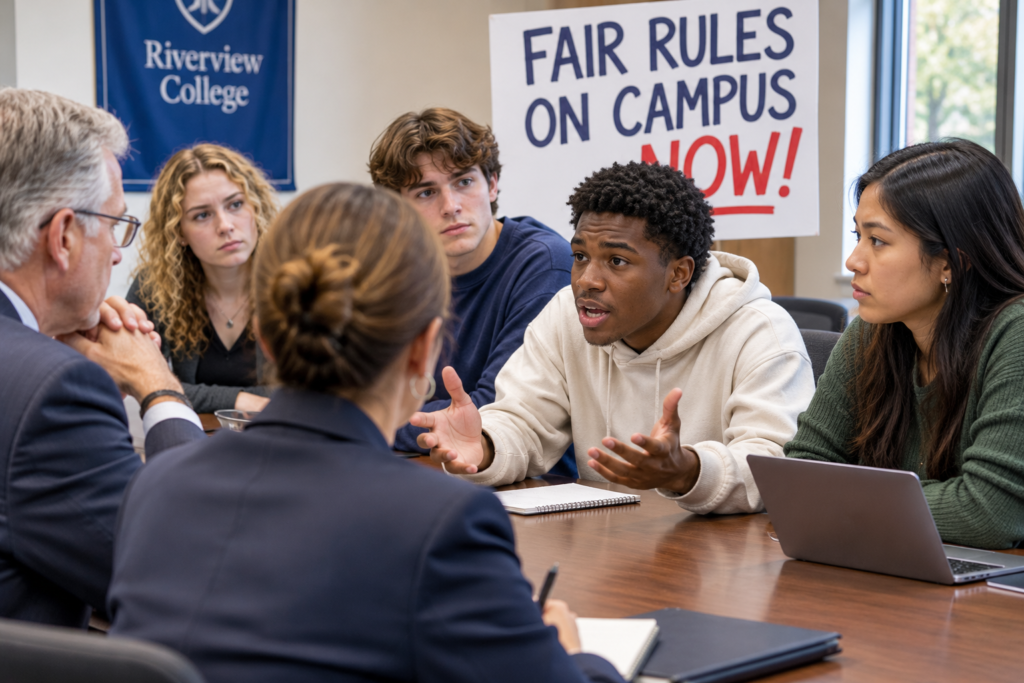
Most protest-related discipline isn’t brought under a rule called “no protesting.” It arises under general conduct provisions and demonstration policies. Search your student handbook for these categories, and read how each defines its terms, because the definition often decides the case:
- Disruption of university functions or interference with others’ access to classes, offices, or events.
- Failure to comply with a university official’s lawful instruction, such as an order to move or disperse.
- Demonstration and expressive-activity policies that set designated areas, quiet hours, advance-notice expectations, or limits on amplified sound, tents, and chalking.
- Building access and hours rules, including occupying a building after closing.
- Face-covering or identification rules adopted by some schools in recent years.
- Harassment and discrimination policies, which can be applied to protest-related speech or conduct.
- Housing and student-organization rules, which can carry their own sanctions, including loss of recognition for a group.
- Trespass after notice, which can turn a conduct case into a police matter.
Due Process: What a College Must Do Before It Disciplines You
At public colleges
Public colleges must follow constitutional due process when discipline threatens a student’s education. The landmark case is Dixon v. Alabama State Board of Education (5th Cir. 1961), which held that students at a public college can’t be expelled for misconduct without notice and an opportunity to be heard. In Goss v. Lopez (1975), a case about public-school suspensions, the Supreme Court said a student facing suspension must receive notice of the charges and a chance to tell their side, with more formal procedures appropriate as the penalty grows more serious. Courts also recognize that a school may remove someone who poses an ongoing danger right away, as long as a hearing follows as soon as practicable.
Those cases set a floor. Most college codes of conduct go well beyond it, with written charges, evidence review, a hearing, and an appeal.
At private colleges
The Due Process Clause doesn’t apply to private institutions, but courts frequently treat the student handbook as a contract. A private school is generally expected to follow its own published procedures and to act with basic “fundamental fairness.” If a handbook promises five days’ notice before a hearing and the school gives you one, that can be a breach. State law adds another layer, so rules differ from state to state.
What a fair process usually looks like
| Stage | What You Should Expect | What To Ask For |
| 1. Notice | A written description of the alleged violation, the rule cited, the date and place, and how the process works. | The exact policy section and a copy of the charge letter. |
| 2. Evidence | Access to the reports, video, or statements the school will rely on. | A written request for all evidence and the names of any witnesses. |
| 3. Hearing or meeting | A real chance to explain your side and present evidence or witnesses. | Whether you may bring an advisor, and the date, format, and time limits. |
| 4. Decision | A written finding and a stated sanction. | The standard of proof the school used and the reasons for the outcome. |
| 5. Appeal | A defined window and set grounds for appeal. | The deadline in writing. Calendar it immediately. |
| 6. Interim measures | Some schools impose temporary restrictions or suspension before a hearing for safety reasons. | The basis for the restriction and when it will be reviewed. |
What Discipline Can Look Like
Sanctions range from a warning to permanent removal. The consequences often reach beyond the campus conduct office, so it’s worth understanding how each level can affect your enrollment, aid, and future applications.
| Sanction | What It Means | Possible Knock-on Effects |
| Warning or reprimand | A written notice that conduct violated policy. | Usually stays in your conduct file; may count against you if there is a later incident. |
| Disciplinary probation | A set period of heightened scrutiny. | A further violation can bring harsher penalties; some schools limit leadership roles or travel. |
| Loss of privileges or housing | Removal from a residence hall, or suspension of a student group. | Housing costs, relocation, or loss of a club’s funding or recognition. |
| Suspension | A temporary separation from the school. | Lost tuition or credits, aid eligibility questions, and possible transcript notation at some schools. |
| Expulsion | Permanent separation. | Transcript notation at some schools; transfer and graduate applications may ask about it. |
| Criminal referral | Police involvement for trespass, property damage, or similar. | A separate legal process with its own consequences, independent of the conduct hearing. |
Check what future applications ask. Many transfer and graduate-school applications, and some professional licensing applications, ask whether you’ve been disciplined or suspended. Scholarships, financial aid packages, and athletic eligibility often require “good standing,” so read the terms of each award before an incident, not after.
What’s Changed Lately: State Laws, Federal Pressure, and Stricter Enforcement
State protest laws, including Texas SB 2972
Texas passed Senate Bill 2972 in 2025, and it took effect on September 1, 2025. It directs public colleges to bar expressive activity on campus between 10 p.m. and 8 a.m. and to limit sound amplification, percussion instruments, and invited speakers during the last two weeks of academic terms. It also requires disciplinary sanctions for violations. Supporters, including its legislative sponsor, pointed to the 2024 campus protests as the reason order-keeping rules were needed. Critics, including FIRE and PEN America, argue the law gives administrators broad power to punish speech that is clearly protected.
Students and student groups sued, and a federal judge temporarily blocked key parts of the law in 2025. A federal appeals court heard arguments on the challenge on October 6, 2026, and had not issued a ruling at the time of that reporting. The ACLU of Texas notes that some provisions have been found likely unconstitutional but may still be in effect at many campuses, so Texas students should check their school’s current policy. Other states have also passed or proposed new campus protest restrictions, and some of those carry penalties beyond campus discipline, so students everywhere should check their own state’s law.
Federal pressure and Title VI
Federal officials have pressed universities to take a tougher line on protest-related disruption and harassment, citing the schools’ obligations under Title VI of the Civil Rights Act, which bars discrimination on the basis of race, color, or national origin at institutions that receive federal funds. In an April 2025 letter to Harvard, for instance, the administration demanded stronger enforcement of protest rules and meaningful discipline for violations, and the Justice Department has since sued the university over its Title VI compliance. Harvard and other universities have contested parts of these demands, and the litigation is ongoing.
What this means for students: harassment and discrimination complaints connected to protests are being taken seriously, and campus conduct offices may enforce existing rules more strictly than they did in the past. Civil liberties groups caution that stricter enforcement shouldn’t come at the cost of protected speech or fair process. Both concerns are legitimate, and both are shaping how colleges write and apply their rules right now.
Special Situations: International Students, Scholarship Holders, and Student Employees
International students
A campus conduct case and an immigration case are separate systems, but they can intersect. Since 2025, there have been well-publicized reports of student visa revocations connected to protest activity, and a recent analysis reported by The Chronicle of Higher Education suggested that international students at politically active campuses faced added scrutiny. If you hold an F-1 or J-1 status, talk with your school’s designated school official (DSO) and, ideally, an immigration attorney before taking part in a protest or responding to a conduct charge. Don’t assume your school’s conduct office can advise you on immigration consequences.
Scholarship, aid, and athletic eligibility
Many scholarships, financial aid packages, and athletic agreements require students to remain in good standing. A disciplinary finding, even without suspension, can trigger a review. Read the terms of each award and ask the awarding office, in writing, what counts as a violation.
If You’re Accused: A Step-by-Step Guide
- Read the notice carefully and note every deadline. Missing a response date can forfeit rights.
- Preserve evidence. Save your own photos, videos, texts, and social posts. Don’t delete anything.
- Get the exact policy language the school says you violated, then compare it to what actually happened.
- Request the school’s evidence in writing, including reports, video, and witness statements.
- Ask about advisors. Find out whether you may bring an advisor or attorney, and look at student legal services, a campus ombuds office, or a civil liberties organization such as FIRE or your state’s ACLU affiliate.
- Be careful with statements if police are involved or a criminal referral is possible. Talk to a lawyer before giving a detailed account.
- Prepare a short, factual statement that explains what you did, where, and why it didn’t violate the rule as written, or why the penalty is out of line.
- Document unequal enforcement if others engaged in similar conduct and weren’t charged.
- Appeal on time. Know the grounds, such as procedural error, new evidence, or a disproportionate sanction.
- Know your outside options. Students at public schools may have First Amendment and due process claims; students at private schools may have contract claims. Deadlines for those claims can be short.
Before You Protest: A Practical Checklist
- Find out whether your school is public or private, and read its demonstration and expressive-activity policy.
- Learn the designated areas, quiet hours, and any notice or registration expectations.
- Choose a point person who can speak with campus officials and law enforcement.
- Don’t block entrances, hallways, or classrooms, and don’t occupy buildings after hours.
- If an official gives a lawful order to disperse, comply first and challenge it afterward through the proper channels.
- Carry your student ID and know the number for campus legal or student advocacy services.
- International students: know how to reach your DSO and an immigration attorney.
- Know the difference between a conduct charge and an arrest. They run on separate tracks and may need separate advice.
Frequently Asked Questions
Can a college suspend or expel you for protesting?
Yes, if you violate a conduct rule and the school follows a fair process. A public college can’t suspend or expel you merely for expressing a protected viewpoint. Still, it can act on neutral violations such as blocking a building, damaging property, or harassing others. Private colleges have more leeway but must generally follow their own handbook.
Do private colleges have to protect student free speech?
Not under the First Amendment, which applies to government actors. Many private colleges promise free expression in their policies, and those promises can be enforced as contract commitments. Some states, such as California through its Leonard Law, extend free-speech protections to students at many nonreligious private colleges.
Can a college ban protests altogether?
A public college can’t ban protest outright, but it can set reasonable, content-neutral time, place, and manner rules. Courts have been skeptical of sweeping blanket bans, and new state laws such as Texas SB 2972 are being tested in court right now. Private colleges have broader discretion but must follow their own published rules.
Do I have a right to a hearing before I’m disciplined?
At a public college, constitutional due process requires at least notice of the charges and a chance to respond before a serious penalty such as suspension or expulsion, with limited exceptions for urgent safety situations. At a private college, your right to a hearing usually comes from the handbook and from state contract law.
Can I bring a lawyer to a campus disciplinary hearing?
It depends on the school. Campus hearings are not criminal trials, and there is generally no right to a free lawyer. Many schools let you bring an advisor, who may be an attorney at your own expense, though the advisor’s role may be limited. Check your conduct code and ask early.
Can protesting affect my visa, financial aid, or future applications?
It can. A disciplinary finding may affect scholarship or aid good-standing requirements, appear on transfer or graduate applications, and for international students may raise immigration questions that a campus office can’t resolve. Talk to your financial aid office, your DSO, and a qualified attorney as needed.