What Happens When Your College Closes? How to Protect Your Credits, Financial Aid, and Degree
Share this on:


Find your perfect college degree
In this article, we will be covering...
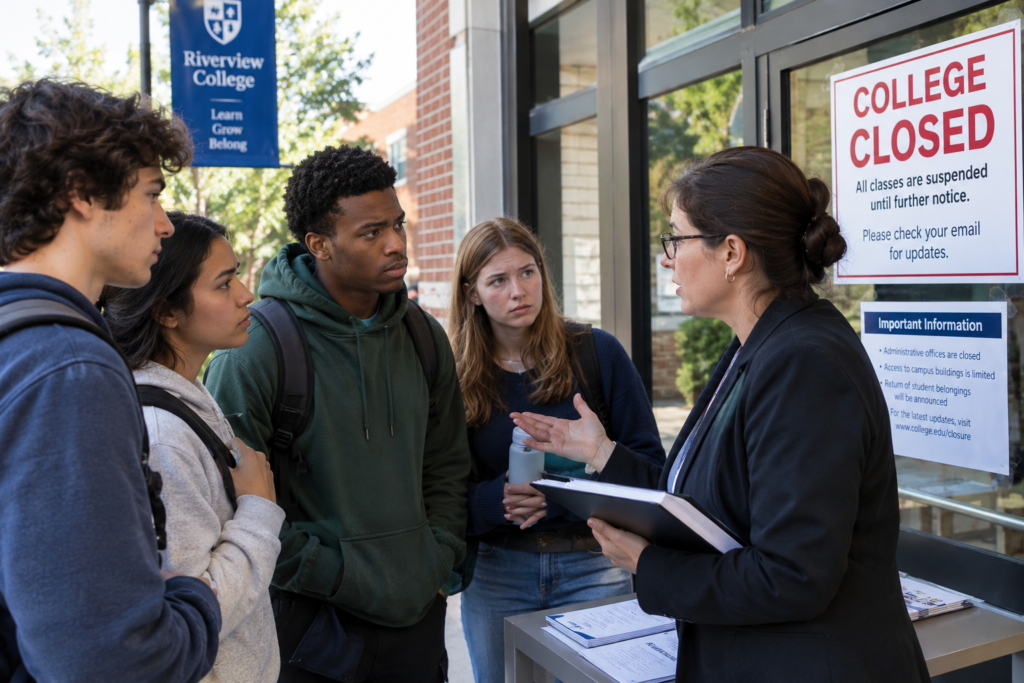
When a college closes, students may face unexpected disruptions to their education, financial aid, and graduation plans. Coursework may be interrupted, academic records may become difficult to access, and students may need to find another institution willing to accept their previously earned credits. Depending on the circumstances, some students may also qualify for federal student loan relief.
If your college closes, act quickly to obtain your academic records, confirm your financial aid status, investigate transfer options, and determine whether you qualify for a closed school loan discharge. Your next steps depend on whether the institution has permanently closed, arranged for students to finish their programs elsewhere, or stopped operating while still maintaining a teach-out arrangement.
The good news is that a college closure does not automatically mean you must start your degree from scratch. With the right documentation and a clear transfer strategy, you may be able to preserve much of your academic progress.
What Happens When a College Closes?
When a college shuts down, students may experience several consequences depending on the institution’s closure plan and their enrollment status.
- Interrupted classes: Students may lose access to courses, faculty, campus facilities, and online learning platforms.
- Uncertain academic records: Transcripts, grade reports, and other records may become harder to obtain if the institution stops operating.
- Transfer complications: Another college may accept some, but not necessarily all, of the credits earned at the closing institution.
- Financial aid changes: Grants, scholarships, and federal student loans may require additional review when students change schools.
- Delayed graduation: Students may need to complete additional coursework if their new institution does not accept all previously earned credits.
- Possible student loan relief: Eligible borrowers may qualify for a closed school discharge of certain federal student loans.
A closure does not automatically cancel your student loans, guarantee that another college will accept your credits, or entitle you to a refund. Each issue has separate rules and procedures.
Students should begin by checking official announcements from their college and the U.S. Department of Education. The department’s school closure resources provide information about institutional closures and related administrative requirements.
What Should You Do First if Your College Closes?
The first few steps can make a significant difference in protecting your education and finances.
1. Save Your Academic Records Immediately
Download or request copies of your academic records before the institution’s website, student portal, or email system becomes inaccessible.
Prioritize the following documents:
- Official and unofficial transcripts
- Grade reports and completed-course records
- Course descriptions and syllabi
- Degree audits and graduation progress reports
- Enrollment verification and attendance records
- Proof of completed internships, clinical rotations, or other required practical training
- Financial aid award letters and account statements
- Tuition receipts and loan documentation
Course syllabi and descriptions are particularly useful when applying to transfer credits. They help another institution compare the content, learning outcomes, and academic level of courses you have already completed.
If you cannot obtain your transcript directly from the college, contact the state agency responsible for licensing or authorizing the institution. The U.S. Department of Education explains that state licensing agencies may arrange for academic records to be retained after a school closes. See the department’s official transcript guidance.
2. Find Out Whether a Teach-Out Plan Exists
A teach-out plan is an arrangement intended to help students complete their education when an institution or program is closing.
Depending on the arrangement, students may be able to finish their coursework at the original institution before it shuts down or continue their studies at another institution. Some arrangements involve a receiving college that agrees to offer courses or help students complete a comparable program.
Ask your college’s administration or closure contact:
- Is there an approved teach-out plan?
- Which institutions are participating?
- Will students be able to complete the same degree or a comparable program?
- What tuition, fees, and additional requirements will apply?
- Will previously earned credits be accepted?
- What happens to students who do not want to participate in the arrangement?
Do not assume that a teach-out arrangement guarantees a degree on the original terms. Review the receiving institution’s requirements, costs, accreditation status, and degree-completion conditions before agreeing to transfer.
A teach-out option may be convenient, but students should compare it with other transfer opportunities to determine which path best protects their academic progress.
How to Transfer Your College Credits After a School Closes
Transferring to another institution is often the most practical way to continue your education after a closure. However, credit transfer is not automatic.
Each receiving college generally evaluates prior coursework according to its transfer-credit policies, program requirements, and academic standards.
Step 1: Identify Colleges That Offer Your Degree
Start by identifying accredited institutions that offer the same or a closely related program. Consider public universities, private colleges, community colleges, and online institutions where appropriate.
Compare the institutions based on:
- Whether your major is available
- Transfer-credit policies
- Remaining degree requirements
- Tuition and fees
- Program accreditation where relevant
- Graduation timelines
- Availability of online, evening, or part-time courses
If you are close to graduation, prioritize institutions that can evaluate your existing credits quickly and provide a written degree-completion plan.
Step 2: Request a Transfer-Credit Evaluation
Contact the admissions office or registrar at each prospective institution. Explain that your current college has closed and ask how the school evaluates coursework from closed institutions.
Submit the documents requested, which may include transcripts, course descriptions, syllabi, and evidence of completed practical training.
Ask for a written evaluation showing:
- Which credits will transfer
- Which requirements those credits will satisfy
- Which courses you still need to complete
- Whether any courses must be repeated
- Your estimated time to graduation
A college may accept a course as elective credit without allowing it to satisfy a required major course. Therefore, the total number of accepted credits does not necessarily equal the number of credits that count toward your degree.
The Federal Student Aid office provides additional guidance on transferring to another college, including articulation agreements and transfer-credit policies.
Step 3: Compare Your Options Before Enrolling
Do not select a receiving institution solely because it promises to accept the most credits.
Compare the total cost of completing your degree, including tuition, fees, additional courses, and the possibility of extending your enrollment. Also verify that the program meets any licensing or professional accreditation requirements relevant to your career.
Ask the receiving institution to explain its transfer decision in writing. If important credits are rejected, provide additional course documentation and ask whether the decision can be reconsidered.
Step 4: Confirm Your Graduation Requirements
Once you enroll, obtain an updated degree audit from your new institution.
The audit should identify the credits accepted, outstanding general education requirements, major courses, minimum residency requirements, and any other conditions for graduation.
Keep copies of this evaluation throughout your studies. It will help you monitor progress and resolve discrepancies before your intended graduation date.
What Happens to Your Financial Aid When a College Closes?
Your financial aid does not necessarily follow you automatically to another institution. You may need to update your financial aid information, complete additional paperwork, and meet the receiving school’s eligibility requirements.
Federal Pell Grants and Other Grants
If you received a Federal Pell Grant or another form of federal aid, contact the financial aid offices at both your former and prospective institutions, where possible.
Ask whether your previous aid was disbursed correctly, whether any funds must be returned, and how the closure affects your remaining eligibility.
Students who transfer should review their FAFSA information and make sure the new institution is included where required. The receiving college will determine your eligibility for aid at that school.
In certain circumstances, students affected by a school closure may also qualify for restoration of federal grant eligibility. The availability of relief depends on the applicable rules and the student’s circumstances. Confirm eligibility with the Department of Education or the new institution’s financial aid office.
Scholarships and Institutional Aid
Scholarships awarded by a closing college may not transfer to another institution.
Contact each scholarship provider to determine whether the award can be transferred, whether you must submit a new application, or whether the scholarship ends when you leave the original institution.
External scholarships may have separate requirements concerning enrollment status, major, GPA, or the type of institution attended.
Federal Student Loans
Federal student loans require particular attention because a school closure may affect both enrollment and repayment obligations.
Contact your loan servicer to confirm your loan status and ask whether any school-closure provisions apply. If you enroll in another eligible program, your enrollment status and loan repayment obligations will depend on the applicable federal rules.
Do not assume that your loans will be canceled simply because your college closes. Loan discharge is a separate process with specific eligibility requirements.
For official guidance, visit Federal Student Aid’s loan discharge and forgiveness page.
Can You Get Your Student Loans Forgiven if Your College Closes?
Some students may qualify for a closed school loan discharge, which can eliminate eligible federal student loan debt associated with a school that closed before they could complete their program.
Eligibility depends on the loan type, the timing of the closure and withdrawal, whether the student completed the program, and whether the student is completing a comparable program elsewhere.
Generally, a borrower may qualify when the school closes while the student is enrolled or within an applicable period after the student withdraws. The precise timing requirements depend on the rules that apply to the borrower’s circumstances.
Students who completed all required coursework before the closure may not qualify merely because they have not yet received their diploma. Likewise, students who continue a comparable program through a teach-out arrangement or transfer may be ineligible for a closed school discharge under the applicable rules.
How to Apply for a Closed School Loan Discharge
If you believe you qualify, take the following steps:
- Review the eligibility requirements. Check the official Federal Student Aid guidance for the rules that apply to your loans and enrollment history.
- Contact your loan servicer. Explain the closure and ask whether you qualify for a closed school discharge.
- Gather supporting documents. Keep enrollment records, withdrawal dates, transcripts, loan information, and any communications about the closure.
- Submit the required application or documentation. Follow the instructions provided by Federal Student Aid or your loan servicer.
- Confirm the outcome in writing. Keep the decision and any updated loan-account information for your records.
You should not stop making required loan payments solely because your school has closed. Ask your loan servicer how to handle payments while your eligibility is being reviewed.
Important: A closed school discharge is not automatic in every case, and the rules differ from other forms of student loan forgiveness. Review the current official requirements at Federal Student Aid.
What If Your College Closes Before You Receive Your Diploma?
Students who have completed their coursework but have not received a diploma should contact the institution’s closure administrator, records custodian, or relevant state licensing agency.
Ask for written confirmation of your completed requirements and the process for issuing your degree or certificate.
If the college cannot award your credential, contact other institutions to determine whether they can evaluate your academic record and identify any remaining requirements. However, another college generally cannot simply issue the original institution’s degree.
Keep copies of all evidence showing that you completed the required courses, examinations, internships, clinical placements, or other program components.
Students in regulated fields should also contact the relevant licensing board if the closure affects their ability to meet professional education requirements.
Can You Get a Tuition Refund if Your College Closes?
A college closure does not automatically entitle every student to a full tuition refund.
Refund eligibility depends on factors such as the institution’s policies, applicable state law, the timing of the closure, the services already provided, and the source of the funds used to pay tuition.
If you believe you are owed money, take these steps:
- Request an itemized account statement from the college or records custodian.
- Gather tuition receipts, payment confirmations, and financial aid records.
- Ask the closure administrator about the institution’s refund procedures.
- Contact the state agency responsible for authorizing the school to ask whether a tuition recovery fund or other protection applies.
- Contact your loan servicer if federal loan funds were used to pay charges that were not properly refunded.
Some states operate tuition recovery funds or maintain other protections for eligible students at certain institutions. Coverage is not universal, and eligibility conditions vary.
If you paid tuition through a private loan, credit card, or other financing arrangement, contact the relevant lender or financial institution to ask about available options. A school closure alone does not guarantee cancellation of private debt.
How to Protect Yourself From Future College Closures
Although students cannot predict every institutional closure, they can take steps to reduce the risk of losing academic progress or facing unexpected expenses.
Verify institutional status and accreditation. Check the institution’s recognized accreditation and relevant state authorization. For programs leading to professional licensure, verify any additional program-specific accreditation or approval requirements.
Maintain independent copies of your records. Save transcripts, syllabi, degree audits, financial aid documents, and tuition receipts in a secure location outside your school’s learning management system.
Understand the financial commitment. Review refund policies, enrollment agreements, tuition obligations, and financial aid conditions before enrolling.
Monitor official announcements. Pay attention to communications from the institution, its accreditor, state regulators, and the Department of Education.
Know your transfer options. If your college appears financially unstable or announces a closure, research alternative institutions before the final shutdown. Early planning may make it easier to obtain records and compare transfer decisions.
Ask questions before signing a teach-out agreement. Understand the new institution’s costs, degree requirements, credit-transfer terms, and any limitations before committing.
These steps cannot eliminate every risk, but they can help you make informed decisions if your institution stops operating.
Frequently Asked Questions
Will my college credits disappear if my school closes?
No. Credits you earned do not automatically disappear when a college closes. However, obtaining official records may become more difficult, and another institution is not required to accept every credit. Preserve your transcripts, course descriptions, and grade reports, and contact the relevant state licensing agency if you cannot access your records.
Will another college accept all my credits?
Not necessarily. Each receiving institution evaluates transfer credits according to its own policies and degree requirements. Some courses may transfer as electives rather than satisfy major requirements. Request a written transfer-credit evaluation before enrolling whenever possible.
Does financial aid automatically transfer to another college?
No. Federal student aid generally does not transfer automatically. You may need to update your FAFSA information, complete the receiving school’s financial aid process, and meet its eligibility requirements. Contact the new institution’s financial aid office before enrolling.
Can I get federal student loans discharged if my college closes?
Possibly. Eligible borrowers may qualify for a closed school discharge if the institution closes under circumstances covered by federal rules. Eligibility depends on factors such as enrollment status, withdrawal timing, loan type, and whether the student completes a comparable program elsewhere. Consult Federal Student Aid or your loan servicer for an individual determination.
What happens if my college closes while I am on a leave of absence?
Your eligibility for a closed school loan discharge depends on the applicable federal requirements and your approved leave status. Some borrowers on an approved leave of absence may be treated as enrolled for discharge purposes. Contact your loan servicer and review the official rules rather than assuming that a leave automatically qualifies or disqualifies you.
Who keeps transcripts after a college closes?
The relevant state licensing agency may have arranged for the institution’s academic records to be stored by a designated custodian. Contact that agency to find out where records are held and how to request them. The Department of Education provides official guidance on obtaining records from closed schools.
Can a college closure delay my graduation?
Yes. If your new institution does not accept all your previous coursework, you may need to complete additional classes or meet different degree requirements. Obtain a transfer-credit evaluation and updated degree audit as early as possible to understand the potential effect on your graduation timeline.
Final Thoughts
A college closure can create serious academic and financial challenges, but it does not necessarily mean losing all your progress toward a degree. Students who act quickly can improve their chances of obtaining academic records, transferring credits, preserving financial aid eligibility, and identifying potential loan relief.
Start by securing your records, contacting the relevant state licensing agency if necessary, and asking whether a teach-out plan is available. Then compare transfer options, obtain a written degree-completion plan, and review your financial aid and loan status.
Most importantly, verify every transfer and financial aid decision with the institution or agency responsible for it. Policies differ, and a written confirmation can help you avoid costly misunderstandings while you work toward completing your education.