How AI Is Changing the Way Community Colleges Deliver Remedial Education Across the U.S.
Share this on:


Find your perfect college degree
In this article, we will be covering...
What You’ll Learn in This Article
- What remedial (developmental) education is and why it has historically struggled to serve students well
- How AI-powered tools are being deployed in community college classrooms right now
- Which specific platforms, programs, and institutions are leading this transformation
- What the research says about outcomes, and where the evidence is still thin
- What this shift means if you or someone you know is entering a community college developmental education sequence
What Is Remedial Education at Community Colleges?
Remedial education, also called developmental education or developmental coursework, refers to non-credit or pre-college-level courses in math, reading, and writing that community colleges offer to students whose placement assessments indicate they are not yet prepared for college-level work.
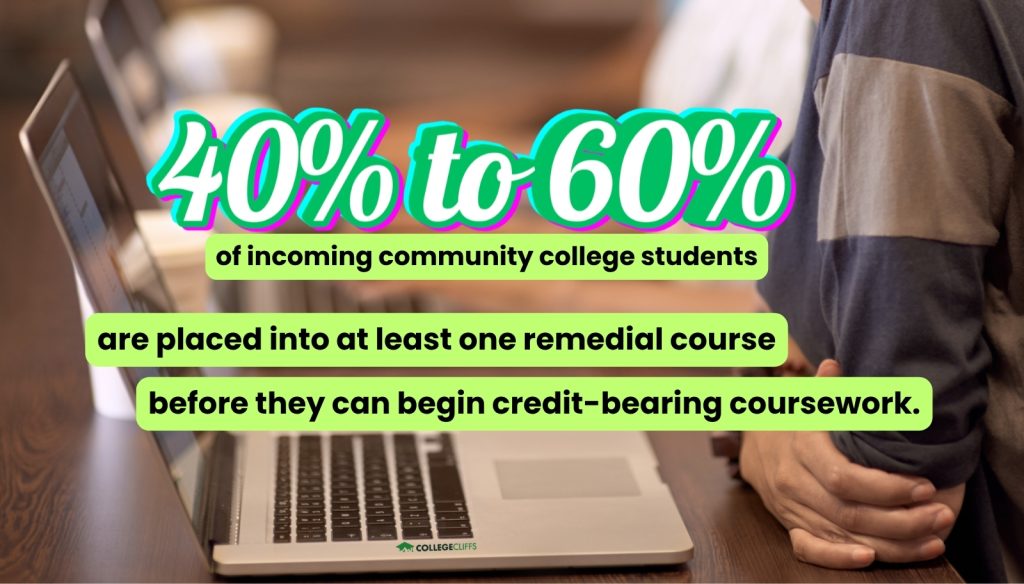
Approximately 40 to 60 percent of incoming community college students are placed into at least one remedial course before they can begin credit-bearing coursework. For many of these students, remedial sequences become a significant barrier: research has consistently shown that students placed multiple levels below college-ready math or English face dramatically lower odds of ever completing a degree or certificate.
The reasons are structural. Traditional remedial models require students to pass one or more non-credit courses before earning a single transferable credit, adding semesters, costs, and complexity to an already fragile pathway. Many students, especially adult learners balancing work and family, simply don’t make it through.
This is the problem AI is now being asked to help solve.
Why Remedial Education Is Ripe for AI Disruption
The structural weaknesses of traditional developmental education align almost perfectly with what AI-powered adaptive learning systems do well:
- Heterogeneous student preparation: No two remedial students arrive with the same gaps. One may struggle with fractions but excel at algebra concepts; another may have the reverse profile. Static, one-size-fits-all remedial courses cannot address this variation. Adaptive AI can.
- High volume, limited staffing: Community colleges serve enormous numbers of students with comparatively lean instructional staff. AI tutoring tools can provide unlimited, personalized practice at a cost per interaction that no human tutoring program can match.
- High-stakes, emotionally loaded content: Many adult learners returning to school carry years of math or writing anxiety. AI-driven platforms can offer patient, non-judgmental, infinitely repeated practice in a lower-stakes environment than a traditional classroom.
- Need for rapid skills diagnosis: Knowing exactly which foundational gaps a student has, at the level of individual skills, allows instructors to intervene precisely. AI diagnostic engines can do this assessment in minutes with greater granularity than standardized placement tests.
How AI Is Being Deployed in Community College Remedial Education: Six Key Approaches
1. AI-Powered Adaptive Learning Platforms
The most widespread AI application in developmental education is adaptive learning software, or platforms that adjust the difficulty, pacing, and type of instructional content in real time based on each student’s performance.
Carnegie Learning’s MATHia is one of the most extensively studied examples. Developed out of Carnegie Mellon University’s cognitive science research, MATHia uses an AI model to track each student’s mastery of specific math skills, identify the precise point of confusion, and route students through individualized problem sets. Community colleges using MATHia for developmental math have reported measurable improvements in student pass rates compared to traditional lecture-only formats.
ALEKS (Assessment and Learning in Knowledge Spaces), now owned by McGraw-Hill, uses a similar knowledge-space theory model to build a detailed map of what each student knows and doesn’t know, then delivers targeted instruction on the most productive next skill to learn.
These platforms are not AI in the large language model sense. They use structured knowledge models and probabilistic mastery estimation. But they represent the most battle-tested and evidence-supported form of AI in this space.
2. AI Writing Assistants and Grammar Tutors
For developmental English and writing courses, AI tools are increasingly being deployed to provide feedback on student writing that would otherwise require hours of instructor time.
Turnitin’s Feedback Studio, Grammarly for Education, and emerging LLM-powered tools integrated into learning management systems like Canvas and Blackboard can now provide:
- Sentence-level grammar and mechanics feedback
- Paragraph structure and coherence suggestions
- Thesis and argument clarity assessments
- Revision tracking across multiple drafts
The pedagogical argument for these tools is strong: writing improves through practice and feedback, and the limiting factor in most developmental writing courses is the number of drafts an instructor can realistically read and comment on. AI writing assistants remove that bottleneck, allowing students to draft, receive feedback, revise, and repeat. It’s the cycle that research identifies as most effective for writing development.
The caution is equally important: AI writing tools can encourage over-reliance, homogenize student voice, and generate feedback that is grammatically accurate but pedagogically shallow. Instructors are learning to position these tools as first-pass feedback, not a substitute for meaningful human engagement with student ideas.
3. AI Tutoring Chatbots and 24/7 Support
Several community colleges are piloting AI tutoring chatbots that students can access outside of class and office hours, such as in the evenings, on weekends, and during late nights when the tutoring center is closed, and the instructor is unavailable.
Khanmigo, the AI tutoring assistant built on top of Khan Academy’s content library, is being evaluated in several community college settings as a supplement to developmental math instruction. Unlike a search engine or a static explainer video, Khanmigo engages students in Socratic dialogue that involves asking guiding questions rather than simply providing answers, which aligns with established tutoring research on what actually produces learning gains.
Civitas Learning and similar platforms go beyond tutoring to provide AI-driven early-alert systems: they analyze patterns in student behavior (login frequency, assignment completion, quiz scores) to flag students who are at risk of withdrawal before those students have even identified themselves as struggling. Advisors receive prioritized lists of students to contact, allowing limited advising staff to intervene proactively rather than reactively.
4. AI-Driven Placement and Diagnostic Assessment
One of the most consequential reforms to remedial education in recent years has been the movement away from high-stakes, single-test placement into more nuanced, multimeasure assessment. AI is accelerating this shift.
Traditional placement tests like the Accuplacer or Compass assigned students to remedial levels based on a single test score. It is a method that research found to systematically misplace students, often placing them lower than their actual ability warranted. Multiple-measures placement incorporates high school GPA, course-taking history, self-reported confidence, and other signals alongside test scores to make more accurate placement decisions.
AI systems can now synthesize these multiple data streams into placement recommendations that outperform single-measure tests in predicting college-level course success. Some systems are also beginning to distinguish between students who need traditional remediation and students who would be better served by corequisite support. In this model, students take the college-level course and a companion support course simultaneously, rather than completing remediation as a prerequisite.
5. Corequisite Models Powered by Learning Analytics
The corequisite remediation model has been one of the most significant policy shifts in community college education in the past decade. Instead of requiring students to pass standalone remedial courses before attempting college-level math or English, corequisite programs enroll students directly in the college-level course and provide concurrent additional support.
States including Texas, Tennessee, California, and Indiana have mandated or strongly incentivized corequisite models for their community college systems, and the early outcome data have been compelling: students in corequisite programs complete college-level math and English at dramatically higher rates than those in traditional remedial sequences.
AI and learning analytics platforms are now being used to make corequisite models more precise. By continuously monitoring student performance data in the college-level course, AI systems can identify which students need additional support in real time and dynamically adjust the intensity of the corequisite component. Rather than a fixed support course with identical content for all students, AI enables corequisite support that is personalized to each student’s evolving gaps.
6. Intelligent Course Redesign and Instructor Support Tools
AI is not only working directly with students; it is also changing how instructors design and teach developmental courses. AI-powered analytics platforms give instructors dashboards that show, at a glance:
- Which concepts are producing the most errors across the class
- Which students are spending time on the platform versus passively clicking through
- Which instructional sequences correlate with better assessment outcomes
Platforms like Realizeit, deployed at several Florida State College campuses, provide instructors with real-time data on student mastery at the skill level, enabling a shift from lecture-paced instruction to what practitioners call competency-based progression. In it, students advance when they demonstrate mastery, not when the calendar says the semester is half over.
What the Research Actually Says
The evidence on AI in developmental education is promising but still maturing. A few key findings worth knowing:
What the evidence supports:
- Adaptive learning platforms, particularly in developmental math, are associated with improved pass rates and reduced time-to-completion when implemented with strong instructor integration, not as a replacement for instruction, but as a complement to it.
- Early-alert and advising analytics systems show consistent evidence of improving student retention when they result in actual advisor outreach, not just data dashboards that no one acts on.
- Corequisite models (which AI supports but did not create) have strong evidence of improving throughput to college-level completion.
Where the evidence is still thin:
- Long-term outcomes: Do AI-assisted developmental students persist to degree completion at higher rates? The data here is limited.
- Equity effects: Early research raises concerns that some AI placement and adaptive systems may encode historical patterns of underperformance for specific demographic groups, potentially perpetuating rather than reducing inequity.
- Writing development: The evidence that AI writing feedback improves deep writing ability (as opposed to surface-level correctness) is weak. Strong writing requires authentic feedback from human readers who engage with ideas, not just mechanics.
What This Means If You’re Enrolling in Remedial Coursework
1. Your Placement May Be More Flexible Than You Think
If you’re told you’ve been placed in a developmental course, ask whether your college uses multiple-measures placement or whether you can submit a portfolio, high school transcript, or evidence of prior work experience in the relevant subject. Many colleges have updated their placement policies in recent years, and a single placement test score is no longer the final word everywhere.
2. Corequisite Options May Be Available. Ask.
At many community colleges, especially in states that have implemented corequisite reform, you may have the option to enroll in the college-level course with a corequisite support section rather than completing a standalone remedial prerequisite. This matters enormously: completing a college-level course earns transferable credit; completing a remedial course does not.
3. The AI Tools Are Supplements, Not Teachers
If your college uses platforms like ALEKS, MATHia, or AI writing assistants, engage with them seriously, but don’t confuse platform activity with learning. Research consistently shows that AI adaptive platforms work best when students use them to identify gaps, bring those gaps to their human instructor, and engage in practice with genuine effort rather than clicking through to completion.
4. Take Advantage of AI-Enabled Tutoring Hours
If your college has deployed an AI tutoring chatbot or a 24/7 platform like Khan Academy, these tools are most valuable at the moments when human help isn’t available, such as late at night before an exam, on weekends when the tutoring center is closed. Build the habit of using them the moment you hit a wall rather than waiting until the next class session.
5. Talk to Your Advisor Early and Often
AI early-alert systems are generating signals about your enrollment patterns and engagement, and those signals are reaching advisors. But advisors can only help if you respond when they reach out, or better yet, reach out first. The analytics that flag you as “at risk” are also the analytics that prioritize you for support. Use them to your advantage.
6. Know Your College’s AI Use Policy
If you use AI tools to assist with writing assignments in your developmental English course, make sure you understand the course policy on AI-assisted work. Developmental writing courses often explicitly prohibit AI-generated drafts because the goal is to build your own writing skills, and the instructor’s feedback will be calibrated to help you develop, not to evaluate an AI’s output.
Community Colleges Leading the Way: Programs Worth Knowing
Valencia College (Florida) has been a national leader in learning analytics for over a decade, using its LifeMap advising system and Civitas Learning integrations to identify and support at-risk students. Its developmental education redesign work is regularly cited by the Community College Research Center (CCRC) at Teachers College, Columbia University.
The Tennessee Board of Regents oversaw one of the largest-scale corequisite implementations in the country, moving virtually all community college students into corequisite math and English rather than traditional remediation. The outcome data, which are substantially higher college-level course completion rates, have been influential nationally.
California Community Colleges have implemented AB 1705, a 2022 law that significantly restricts when colleges can require students to take developmental coursework, accelerating the adoption of corequisite and directed self-placement models across the state’s 116 colleges.
Houston Community College has deployed adaptive learning in developmental math at scale, with documented improvements in student pass rates in a system serving a predominantly low-income and first-generation student population.
Frequently Asked Questions About AI and Remedial Education
What is remedial education at a community college?
Remedial education (also called developmental education) at a community college refers to pre-college-level coursework in math, reading, or writing designed for students whose placement assessments indicate they are not yet ready for college-level courses. These courses typically do not earn transferable college credit but are required prerequisites for credit-bearing courses at many institutions.
How is AI being used in community college remedial education?
AI is being used in community college developmental education in several ways: adaptive learning platforms that personalize math and reading instruction (such as ALEKS and MATHia), AI writing assistants that provide automated feedback on student drafts, AI tutoring chatbots available outside class hours, early-alert systems that flag at-risk students for advisor outreach, and AI-assisted placement systems that use multiple data points to make more accurate course placement decisions.
Does AI improve outcomes for remedial students?
The evidence is promising but mixed. Adaptive learning platforms in developmental math have shown measurable improvements in pass rates when implemented alongside instructor support. Early-alert systems improve retention when advisors actually act on the data. However, evidence on long-term degree completion outcomes and equity effects is limited, and concerns remain about whether AI tools may encode and perpetuate existing inequities in student preparation.
What is corequisite remediation, and how does AI support it?
Corequisite remediation is a model in which students who would traditionally be placed in developmental (non-credit) courses are instead enrolled directly in college-level courses with simultaneous additional support built in. AI supports corequisite models by using learning analytics to identify, in real time, which students need more intensive support and in which specific skills, allowing corequisite sections to be more responsive and targeted than fixed-content support courses.
Can AI replace developmental education instructors?
No. Research consistently shows that AI-powered adaptive learning platforms and tutoring tools work best as complements to human instruction, not replacements for it. The relationship between a skilled developmental education instructor and a struggling student involves emotional intelligence, motivational support, and real-time pedagogical judgment that current AI systems cannot replicate. The colleges seeing the best outcomes from AI tools are those where instructors are trained to use the data these tools generate to inform their teaching.
What should I do if I’ve been placed in a remedial course?
If you’ve been placed in a developmental course, you have several options worth exploring: ask whether your college offers multiple-measures placement (which can account for your high school GPA or other factors beyond a single test score), inquire whether a corequisite option is available that would allow you to earn college credit simultaneously, and speak with an academic advisor about the fastest pathway to your degree or certificate goal. Placement is a starting point, not a permanent label.
Are AI tools in remedial education available to all students equally?
Equitable access is an active concern in this field. AI-powered platforms require reliable internet access and devices, which not all community college students have. Additionally, some research has raised concerns about AI systems that may reflect historical patterns of underperformance for certain demographic groups in their training data. Institutions are increasingly aware of these equity risks, and leading colleges are pairing technology adoption with explicit equity analysis of outcomes.
The Bottom Line
Remedial education at community colleges has long been one of higher education’s most stubborn equity challenges: a system designed to help underprepared students catch up that too often became a barrier that prevented them from ever catching up at all. AI is not a magic solution to that problem. But it is providing tools that, when implemented thoughtfully and equitably, can make developmental pathways faster, more personalized, and more likely to lead to the credentials students came for.
The students who will benefit most are those who understand what these tools can and cannot do. AI benefits those who use AI-powered platforms as serious learning instruments, who engage with advisors using the data those systems generate, and who advocate for placement processes and course options that reflect their actual abilities and goals.
Community college is built on the idea that it’s never too late to start. AI is beginning to make the start line a little easier to reach.