Gen Ed in the Age of AI:Why Critical Thinking Requirements Are Making a Comeback on U.S. Campuses
Share this on:


Find your perfect college degree
In this article, we will be covering...
Colleges across the country are overhauling their general education requirements not to add AI courses, but to protect something AI threatens to replace: the ability to think for yourself.
Quick Answer
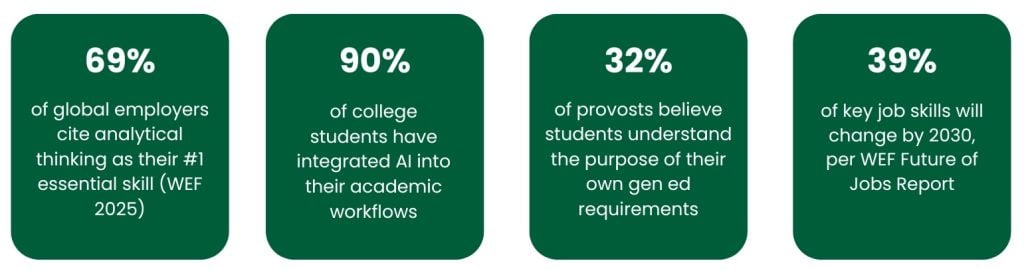
U.S. colleges are formally adding critical thinking, reasoning, and AI ethics to their general education requirements because research shows heavy AI use may erode students’ analytical skills. At the same time, employers simultaneously report that analytical thinking is their single most essential skill, cited by 69% of global companies in the World Economic Forum’s 2025 Future of Jobs Report. The result is a quiet but significant gen ed reform wave reshaping what it means to earn an undergraduate degree in 2026.
For decades, general education requirements occupied an awkward position in American higher education. Students called them “hurdles.” Faculty designed them with the best of intentions and watched them get slogged through. Administrators revised them on a decade-long cycle. Almost no one talked about them with urgency.
Then came ChatGPT, and the conversation changed overnight.
The arrival of large language models didn’t just disrupt how students complete assignments; it forced universities to confront a deeper question: if AI can draft an essay, summarize a reading, brainstorm arguments, and produce a passing problem set, what exactly is the point of a college education? And if students can outsource the cognitive work that general education requirements were designed to cultivate, are those requirements still doing their job?
At institutions across the country, the answer has been a swift and somewhat surprising one: double down on the human. Not by banning AI, but by formally requiring something AI cannot do. It is the kind of sustained, reflective, skeptical thinking that separates an educated person from a well-prompted machine.
The Problem No One Expected: AI Is Making Students Worse at Thinking
When AI tools first proliferated on college campuses, the dominant concern was plagiarism. Administrators scrambled for detection software. Faculty rewrote syllabi. The word “integrity” appeared in every policy document. What researchers were quietly discovering, however, was a more fundamental problem than cheating: students who leaned heavily on AI weren’t just submitting other work — they were becoming less capable of doing their own.
The term that has entered the academic literature is “digital cognitive atrophy.” Research documented through 2025 indicates that students who extensively use AI for academic tasks show significant decreases in neural activity associated with working memory, analytical reasoning, and independent synthesis. The more a student delegates the thinking to the tool, the less the relevant cognitive machinery gets exercised.
“The disruption of critical thinking skills through AI dependency manifests across multiple cognitive dimensions. Frequent AI users demonstrate reduced neural activation associated with working memory and analytical reasoning.” — Frontiers in Education, October 2025
This is not an argument against AI in the classroom; researchers are careful about that distinction. The issue is not the tool but the posture. A student who uses AI to generate a draft and then critically interrogates it, restructures its argument, and challenges its premises is engaging in genuine intellectual work. A student who copies the output into a submission form is not. The cognitive difference between those two behaviors is vast, and general education reform is now being designed explicitly to cultivate the first and make the second untenable.
Microsoft’s 2025 AI in Education Report found that 37% of students use AI to brainstorm assignments, 33% use it for summarizing information, and 32% use it to receive feedback. This near-universal adoption rate has made prohibition-based approaches obsolete, and forced institutions to pivot from policing AI use to teaching students how to think alongside it.
What Schools Are Actually Doing: The Gen Ed Reform Wave
The reform is not uniform. It is playing out differently at research universities, liberal arts colleges, and community institutions. But across institutional types, a recognizable pattern has emerged: explicit critical thinking requirements are being added, information literacy frameworks are being updated to include AI ethics, and assessment methods are being redesigned to surface reasoning rather than just output.
SUNY System: System-wide mandate
Added “critical thinking and reasoning” and “information literacy” as new gen ed requirements; AI ethics embedded in information literacy starting fall 2026
Cornell University: Curriculum pilot
Piloted a 75-minute asynchronous critical thinking module across six introductory-level courses, providing students with shared frameworks and language for reasoning.
DeVry University: Full-program integration
Embedding AI literacy and critical thinking skills into every single course by the end of 2025, building on a machine learning curriculum launched in 2020
Indiana University: Pedagogy redesign
Large-scale deployment of generative AI tools paired with faculty development programs; redesigned assessment to shift from content transmission to critical reasoning demonstration
Cal State System: Requirement expansion
Multiple campuses (CSUSB, Sacramento State) have formalized critical thinking as a standalone gen ed category with explicit learning outcomes tied to analysis, evaluation, and synthesis.
San Francisco Bay University: Industry co-design
Designed an entirely employer-informed gen ed curriculum with input from 47 Bay Area companies; 10 courses built specifically to deliver “durable skills”, including critical thinking.
The SUNY action is particularly significant given the system’s scale. The State University of New York is one of the largest public university systems in the country, serving over 400,000 students. New students enrolled since fall 2023 must fulfill requirements in critical thinking and reasoning as distinct gen ed categories. Starting in fall 2026, every course satisfying the information literacy requirement will incorporate lessons on AI ethics and literacy, with learning outcomes explicitly extended to “emerging technologies such as artificial intelligence.”
Cornell’s approach is instructive for a different reason. The module grew out of a faculty survey that revealed a troubling gap between intent and reality. “Many of us include critical thinking in our learning objectives,” noted one researcher involved in the project, “but when you look closely at courses, it’s often not taught explicitly.” The AI era has made that gap untenable. You cannot claim to be developing a skill you never directly teach, especially when students have easy access to a tool that can simulate the outputs of that skill on demand.
The Employer Signal: What the Labor Market Is Telling Universities
Colleges do not exist in a vacuum. A clear and consistent signal from the employer community is accelerating the gen ed reform wave. Drawing on survey data from over 1,000 leading global employers representing more than 14 million workers, the World Economic Forum’s Future of Jobs Report 2025 placed analytical thinking at the very top of the skills hierarchy.
| # | Core Skill | % Employers Citing | 2030 Trajectory |
| 1 | Analytical thinking | 69% | ↑ Rising |
| 2 | Resilience, flexibility & agility | 67% | ↑ Rising |
| 3 | Leadership & social influence | 60% | ↑ Rising |
| 4 | Creative thinking | 57% | ↑ Rising |
| 5 | Motivation & self-awareness | 53% | → Stable |
| 6 | Technological literacy | 51% | ↑ Rising fast |
| 7 | Curiosity & lifelong learning | 50% | ↑ Rising |
| 8 | AI & big data fluency | 45% | ↑ Fastest-growing |
What this table makes clear is that the skills employers most urgently want are not skills that AI education by itself delivers. AI and big data fluency are important, but it ranks eighth. The top seven slots belong to distinctly human capabilities: the capacity to reason under uncertainty, adapt to novel situations, lead, create, and maintain the internal motivation to keep learning. These are, not coincidentally, precisely the outcomes that a well-designed liberal arts general education is built to cultivate.
“More than 70 percent of employers say they’d rather hire someone with less experience who understands AI than someone with more experience. That’s a big change.” — Lisa Gevelber, Chief Marketing Officer, Google Gemini · Harvard Business School Conference, November 2025
The Center for Financial Training and Education Alliance has found that “durable skills,” such as critical thinking, problem-solving, communication, and curiosity, appear in job postings 4.7 times more frequently than technical hard skills. Only 51% of graduates believe they had sufficient AI skills for the jobs they applied for, according to the Cengage 2025 Graduate Employability Report, but the deeper problem is that only 30% of 2025 graduates secured full-time work in their field, with nearly half feeling unprepared to apply for entry-level roles at all. The curriculum gap is not primarily a technical one.
Critical Thinking in 2026: A Redefinition, Not Just a Reinforcement
What makes the current gen ed reform different from previous curriculum revision cycles is not just the addition of explicit requirements. It is a genuine reconceptualization of what critical thinking means in an AI-saturated environment. The old definition emphasized analysis and evaluation. The new definition adds a third dimension: the capacity to interrogate AI outputs with appropriate skepticism and to know when human judgment must override algorithmic confidence.
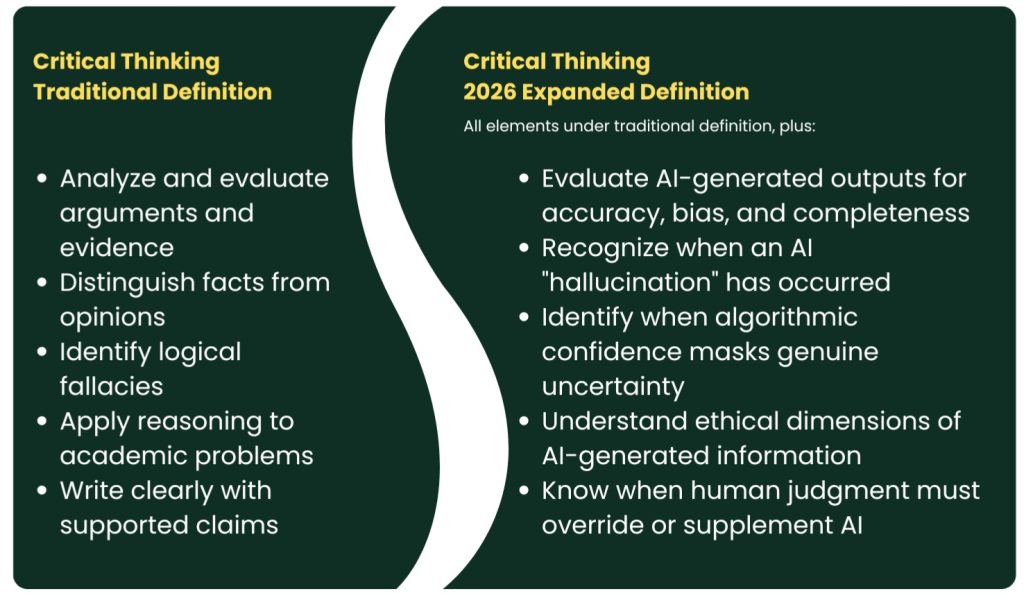
The expanded definition has direct consequences for how gen ed courses are taught and assessed. Institutions are increasingly designing assignments that are structurally resistant to AI delegation: oral defenses of written work, iterative drafts with process documentation, in-person Socratic discussions, and collaborative problem-solving observed by faculty. The goal is not to catch cheaters; it is to create learning contexts where the cognitive work cannot be outsourced, because the cognitive work is the point.
The distinction that matters is not “AI or no AI.” It is “thinking or not thinking.” Researchers at Cornell emphasize that the problem with passive AI use is not the output it produces, but the cognitive engagement it bypasses. When a student asks AI a question and reads the answer without interrogating it, no learning has occurred. When a student uses AI as a Socratic interlocutor, which means pushing back, testing claims, asking for counterarguments, the AI becomes a thinking partner rather than a thinking substitute.
Curriculum redesign in the AI era is fundamentally about structuring the latter experience and making the former visible and teachable rather than invisible and assumed.
The Liberal Arts Counterargument: “We Told You So”
Not everyone in higher education is surprised by this turn of events. Faculty and administrators at liberal arts institutions have spent the past three years watching market pressures push students toward vocational and STEM majors, only to see those same market pressures now validate the foundational claims of a liberal arts education.
The alignment between liberal arts curricula and the demands of AI-era work is not accidental, according to administrators who have been articulating this connection publicly. The emphasis on ethical reasoning, close reading, sustained argumentation, interdisciplinary perspective-taking, and intellectual humility that characterizes a strong liberal arts program turns out to be directly responsive to what employers want and what AI cannot do.
“Critical thinking and judgment have never been more important and are necessary for discerning the use of AI,” said Rachel Bowser, vice president of academic affairs at one liberal arts institution. “We are building on the natural alignment between liberal arts curriculum and the discerning use of AI, along with the natural overlap between students who want an in-person, highly experiential education, and students who want to understand emerging technologies as both sources of problems and solutions.”
San Francisco Bay University offers one of the most direct experiments in employer-aligned gen ed redesign. The institution developed its entire general education curriculum with input from 47 leading Bay Area technology companies. From that engagement, ten courses were designed to deliver what the industry called “durable skills” like critical thinking, empathy, and problem-solving rather than platform-specific technical proficiencies. The result: a 92% student retention rate, including 81% among first-generation and low-income students.
The lesson is not that employers should design curricula. It is that when employers are asked what they actually need as opposed to what skills they list in job postings, they consistently describe outcomes that gen ed is well-positioned to develop.
Assessment Redesign: How Universities Are Making Critical Thinking Visible
A gen ed requirement for critical thinking means nothing if it is assessed the same way a content-knowledge course is assessed. The reform wave has therefore triggered a parallel rethinking of how reasoning skills are measured. It is a challenge complicated by both the sophistication of AI outputs and the structural realities of large-enrollment introductory courses.
Oral examination and defense
Several institutions are reinstating oral examination components in introductory courses. This practice largely disappeared from American higher education in the 20th century, but is standard in European universities. An oral defense requires a student to reason in real time, respond to challenges, and demonstrate genuine comprehension rather than adequate assembly of text. It cannot be delegated to an AI.
Process-based portfolios
Rather than evaluating only final products, faculty are increasingly requiring students to document the process of thinking, consisting of annotated bibliographies, draft histories, revision memos, and reflection logs that narrate intellectual development. AI can generate a finished argument, but it cannot authentically narrate a student’s own cognitive journey through a problem.
AI-integrated assignments with critical interrogation
Some faculty have taken the approach of requiring AI use while building in mandatory interrogation steps: students must generate AI outputs, then identify errors, challenge assumptions, supply counterarguments, and document where and why they disagreed with the tool. This approach treats AI as a foil for critical thinking rather than a replacement for it.
Cross-disciplinary reasoning modules
Cornell’s module is a model of the cross-disciplinary approach: a shared critical thinking framework introduced across departments, giving students a common language for reasoning that transfers across their entire curriculum. The module is explicitly designed to be discipline-agnostic, because critical thinking is not a writing skill or a math skill; it is a meta-cognitive skill that applies everywhere, including to the evaluation of AI outputs.
What This Means for Students Choosing a College in 2026
If you are selecting a college today, the state of its general education requirements is a meaningful signal about the kind of education you will receive, and about how well-prepared you will be for a labor market that increasingly rewards the cognitive capabilities AI cannot replicate.
Institutions that have explicitly added critical thinking as a gen ed requirement, redesigned information literacy to include AI ethics, and updated assessment methods to require demonstrated reasoning are investing in your long-term employability. The 69% of employers who call analytical thinking essential are not looking for graduates who can prompt AI effectively. They are looking for graduates who can evaluate what AI produces, override it when it is wrong, and supply the judgment that no model can.
Conversely, institutions whose gen ed frameworks have not been updated since before 2023 and whose assessments can be substantially satisfied by AI-generated work may be granting credentials that do not signal the capabilities employers most want.
Only 32% of college provosts believe that students at their institutions understand the purpose of their gen ed requirements, according to Faculty Focus research. The institutions most likely to close that gap are those redesigning gen ed not as a compliance exercise, but as a direct response to what AI has revealed about the genuine irreplaceable value of human reasoning.
The Big Picture: Gen Ed Is No Longer a Hurdle. It Is the Point.
The arrival of AI in higher education has done something unexpected: it has restored the intellectual case for general education requirements. When AI can handle content delivery, content mastery, and content production, the value of a college education concentrates on something AI cannot automate: the capacity to think critically, reason ethically, evaluate uncertainty, and exercise judgment. General education requirements that develop those capacities are not boxes to check on the way to a major. They are the primary mechanism by which a college education differentiates itself from a very good search engine.
The reform wave underway at SUNY, Cornell, California State, DeVry, Indiana University, and dozens of other institutions is not a reaction against AI. Rather, it is a clarification of what higher education is for. In 2026, that clarification has never been more consequential or more timely.
Frequently Asked Questions
Why are colleges adding critical thinking to general education requirements?
Colleges are formally adding critical thinking requirements to gen ed because research on AI dependency reveals that students who offload cognitive work to AI tools show reduced analytical reasoning skills. This is a phenomenon researchers call “digital cognitive atrophy.” At the same time, employer demand for analytical thinking has reached record highs: 69% of global employers in the WEF’s 2025 Future of Jobs Report call it their most essential core skill. These two pressures are a cognitive threat from below and a skills demand from above. They have made explicit critical thinking requirements a priority at institutions across the country.
Which U.S. colleges have added critical thinking to their gen ed requirements?
The SUNY system added critical thinking and reasoning and information literacy as new general education requirements starting fall 2023, with AI ethics embedded in information literacy courses from fall 2026. Cornell University piloted a cross-disciplinary critical thinking module in six introductory courses. California State University campuses, including CSUSB and Sacramento State, have formalized critical thinking as a standalone gen ed category. DeVry University is embedding AI literacy and critical thinking into every course. Indiana University has redesigned its assessment to require demonstrated reasoning rather than content output.
Does AI use hurt critical thinking skills in college students?
Research suggests that heavy AI reliance, specifically, passive use where students accept AI outputs without interrogation, is associated with reduced neural activation in areas tied to working memory and analytical reasoning. Researchers call this pattern digital cognitive atrophy. However, strategic AI use, which is essentially treating AI as a thinking partner to interrogate, challenge, and build upon, can deepen learning. The critical variable is not whether students use AI but how they engage with its outputs. Gen ed reform in 2026 is specifically designed to develop the second kind of engagement.
What is “digital cognitive atrophy” in college students?
Digital cognitive atrophy is a term used by researchers to describe the reduction in cognitive engagement and skill that can follow from habitual AI dependency. Students who routinely offload analysis, writing, and synthesis to AI tools may experience decreased activation of neural pathways associated with working memory and critical reasoning. The concept is driving curriculum redesign at colleges that aim to structure learning so that cognitive effort cannot be delegated to a tool because that effort is the point of the exercise.
What do employers want from college graduates in the age of AI?
According to the World Economic Forum’s Future of Jobs Report 2025, the top skill employers want is analytical thinking, cited by 69% of companies as a core essential. This is followed by resilience and flexibility, leadership, creative thinking, and curiosity. AI and big data fluency ranks eighth. The pattern reveals that employers most value human-centric cognitive capabilities, including judgment, synthesis, adaptability, and reasoning, precisely because AI handles routine cognitive tasks, shifting the premium to skills machines cannot replicate.
How is gen ed changing because of AI in 2026?
General education is changing in three main ways in 2026. First, explicit critical thinking requirements are being added as standalone gen ed categories rather than assumed outcomes of coursework. Second, AI literacy and ethics are being integrated into existing information literacy requirements, as SUNY is doing starting fall 2026. Third, assessment design is being overhauled to surface genuine reasoning: oral defenses, process portfolios, and AI-interrogation assignments that require students to evaluate and push back on AI outputs rather than just produce them.