Degrees That AI Can’t Replace: The College Majors Best Positioned for the Next Decade
Share this on:


Find your perfect college degree
Quick Answer
The college majors best positioned for the next decade are those requiring human judgment, physical presence, ethical reasoning, emotional intelligence, and creative originality — qualities AI can simulate but not authentically provide. Top AI-resistant degree paths include nursing and healthcare, skilled trades and engineering technology, social work and counseling, law, education, fine and performing arts, theology, and hands-on sciences. Choosing a major based solely on AI-resistance is not enough — the strongest graduates will be those who combine human-centered skills with AI literacy.
Why Some Degrees Are More AI-Resistant Than Others
The anxiety surrounding artificial intelligence and the future of work is real — and for good reason. Generative AI tools are now writing code, drafting legal memos, generating marketing copy, composing music, analyzing data, and producing imagery that rivals professional output. For students choosing a college major, the question “will this degree still matter in ten years?” has never felt more urgent.
But the question itself reveals a misunderstanding of where AI actually excels and where it fundamentally falls short.
AI is extraordinarily capable at pattern recognition, data synthesis, language generation, and optimization within defined parameters. It processes known information faster than any human. What it cannot do — at least not in any meaningful or reliable sense — is exercise moral judgment in an ambiguous situation, build genuine trust with a grieving patient, physically repair a collapsed building, inspire a child who has stopped believing in themselves, or make the kind of creative decision that emerges from a lifetime of embodied human experience.
The degrees best positioned for the next decade are not simply those that are “hard for AI to do.” They are degrees that cultivate the human capacities that become more valuable precisely because AI handles so much else. In an economy where routine cognitive labor is increasingly automated, the premium goes to human presence, human accountability, and human connection.
This article examines the specific degree programs, the underlying reasons for their resilience, and the honest caveats students should keep in mind.
The Skills AI Cannot Replicate
Before examining specific majors, it helps to understand what underlying capabilities make certain careers structurally resistant to AI displacement. Research from institutions including Oxford, MIT, and McKinsey Global Institute consistently identifies the following as the hardest human capacities to automate:
Physical dexterity in unpredictable environments. AI-powered robots are advancing rapidly but still struggle with tasks requiring fine motor responses to unstructured, changing physical environments — a surgeon navigating unexpected anatomy, a plumber troubleshooting an unknown pipe configuration, a physical therapist calibrating pressure in response to a patient’s pain expression.
Relational trust and emotional attunement. Humans do not simply want information from other humans — they want to feel understood, validated, and accompanied. A therapist, a teacher, a hospice nurse, or a pastor provides something that cannot be effectively reproduced by a language model, regardless of how empathetic its output sounds.
Ethical judgment under uncertainty. When a social worker must decide whether a child is safe at home, when a judge must weigh competing constitutional principles, when a physician must recommend withdrawing life support — these are not optimization problems. They are moral decisions with irreversible consequences that society entrusts to accountable human beings, not algorithms.
Creative originality grounded in lived experience. AI can generate impressive creative work by recombining and interpolating from existing human output. What it cannot do is create from the wellspring of a specific human life — a perspective forged by suffering, love, displacement, or joy that has never existed before in the world.
Physical presence and licensed authority. Many professions are not merely knowledge-based — they require physical presence, professional licensure, and legal accountability. You cannot deliver a baby, conduct a courtroom trial, or perform structural welding remotely via an algorithm. The license, the presence, and the legal liability all attach to a human being.
Healthcare and Nursing Degrees
Why healthcare degrees are among the most AI-resistant
Healthcare is the sector most often cited by labor economists as structurally protected from AI displacement — not because medicine ignores technology (it embraces it aggressively), but because the core of patient care is irreducibly human.
Nursing (BSN, MSN, DNP). Registered nurses and advanced practice nurses are among the safest career choices in the AI era. Nursing involves physical assessment, hands-on interventions, emotional support, real-time judgment calls, and patient advocacy — tasks that require physical presence, professional licensure, and ethical accountability simultaneously. The U.S. Bureau of Labor Statistics projects nursing to add hundreds of thousands of jobs through 2032, driven by an aging population and healthcare demand that AI cannot address.
AI tools in nursing — predictive analytics, documentation assistance, diagnostic imaging support — make nurses more efficient, not redundant. The licensed human nurse remains legally and ethically indispensable.
Physical Therapy and Occupational Therapy. Physical rehabilitation requires a practitioner who can observe movement, feel muscle tension, respond to patient discomfort in real time, motivate a patient who wants to give up, and adjust treatment based on subtle physical feedback. These are profoundly embodied, relational tasks.
Physician Assistant and Medical School Pathways. Medical diagnosis is one area where AI has made genuine inroads — AI systems now outperform radiologists in identifying certain pathologies in imaging scans. However, diagnosing a patient is only one part of medicine. Communicating a terminal diagnosis, navigating a family’s denial, balancing treatment preferences with prognosis, and making individualized decisions about complex comorbidities require human clinical judgment and a therapeutic relationship.
Dental Hygiene, Respiratory Therapy, Surgical Technology. Allied health fields involving direct physical care and procedural skills are broadly protected from AI displacement. Students who want healthcare careers but do not wish to pursue a four-year degree should also know that associate-degree allied health programs are among the most economically resilient paths in higher education.
CollegeCliffs.com Insight: Healthcare degrees offer some of the strongest returns on investment in higher education. The combination of high demand, strong wages, and structural AI-resistance makes nursing and allied health among the clearest “future-proof” major choices available.
Engineering Technology and Skilled Trades
Can AI replace engineers and skilled tradespeople?
This is one of the most misunderstood questions in the AI-and-jobs conversation. The short answer: AI will reshape engineering work significantly, but it will not replace the humans who design, inspect, oversee, build, and maintain physical infrastructure.
Civil and Structural Engineering Civil engineers design infrastructure that will be inhabited, traversed, and depended upon by thousands or millions of people. AI can optimize designs and run simulations — but the professional engineer (PE) who stamps a structural drawing assumes personal legal and ethical liability for that design. Society does not — and likely will never — accept that liability shifting to an algorithm. Civil, environmental, and structural engineering are not just technically demanding; they are legally accountable professions.
Electrical and Mechanical Engineering. The demand for engineers who can oversee AI systems, robotics, and automated manufacturing — rather than be replaced by them — is growing. The engineers designing and maintaining AI hardware, data center infrastructure, electric vehicle systems, and renewable energy grids are precisely the human professionals that an AI-driven economy requires more of, not fewer.
Construction Management. No AI system can manage a job site. Construction project management requires real-time physical assessment, human crew coordination, stakeholder negotiation, safety accountability, and adaptive problem-solving in genuinely unpredictable environments. Construction management degrees are broadly underenrolled relative to industry demand.
HVAC Technology, Welding, and Electrician Programs. Skilled trades are among the most AI-resistant careers in the American economy, full stop. A robot capable of wiring a new residential construction project, diagnosing an industrial HVAC fault, or performing structural welding in a confined space is not a near-term reality. Trades programs at community colleges remain economically exceptional — and increasingly understood as such.
Law and Legal Studies
Will AI replace lawyers?
AI has entered the legal profession in a serious way. Tools like Harvey AI, Lexis+ AI, and CoCounsel are performing legal research, drafting contracts, reviewing documents, and summarizing case law at speeds no human attorney can match. This is already reducing billable hours at large law firms and eliminating some entry-level associate work.
So why does law still appear on this list?
What AI cannot do in law:
- Exercise judicial discretion and moral reasoning
- Advocate with persuasive presence before a judge or jury
- Navigate the political and interpersonal dynamics of a negotiation
- Be held ethically accountable under bar association rules
- Provide legal counsel that requires knowing the full context of a client’s life, relationships, and long-term goals
The law careers most protected from AI:
- Litigation attorneys who conduct trials, examine witnesses, and make real-time strategic arguments
- Family law attorneys navigating the deeply human dimensions of divorce, custody, and adoption
- Criminal defense attorneys whose work is fundamentally about human liberty and constitutional rights
- Judges and magistrates, whose discretionary authority is definitionally human
- Public defenders and legal aid attorneys serving clients whose cases require advocacy, not just document generation
The honest caveat: Law is a field where AI will likely reduce the total number of attorneys needed in certain specializations, particularly corporate transactional work, document-heavy practices, and research-intensive roles. Students choosing law should enter with eyes open about this transformation and develop courtroom, client-relations, and judgment-intensive skills that are genuinely AI-resistant.
Education and Teaching Degrees
Is teaching an AI-proof career?
Teaching is one of the most frequently mischaracterized careers in AI discussions. Technology enthusiasts point to AI tutoring tools, adaptive learning platforms, and AI-generated curricula as evidence that teachers are replaceable. The evidence from education research and classroom practice tells a more complex story.
What AI tutors can do: Deliver personalized practice problems, provide instant feedback on comprehension, adapt content difficulty in real time, and operate 24/7 without fatigue.
What AI tutors cannot do: Notice that a student has stopped engaging because something is happening at home. Build the relationship of trust that makes a struggling adolescent willing to ask for help. Model what it looks like to be a curious, ethical, engaged human being. Create the classroom culture that makes learning possible in the first place. Manage the social and emotional dynamics of 28 children in a room together.
Teaching is not primarily an information delivery profession. It is a human development profession. That distinction matters enormously for AI displacement risk.
Education degrees with the strongest outlook:
- Special Education: Working with students with disabilities requires individualized, relationship-intensive, legally mandated human instruction.
- Early Childhood Education: Young children’s learning is entirely dependent on human attachment, play, and relational development.
- School Counseling: Mental health support in schools is a human relationship, full stop.
- Higher Education Administration. Admissions, advising, and student affairs require nuanced human judgment and institutional knowledge.
- K–12 STEM Education. Schools are actively seeking teachers who can integrate AI literacy into classroom instruction, creating new demand.
Social Work, Counseling, and Psychology
Why human services degrees are structurally AI-resistant
If there is one category of profession that AI is categorically unsuited to replace, it is the human services sector. Social workers, counselors, clinical psychologists, marriage and family therapists, and addiction counselors perform work that is:
- Ethically regulated — These are licensed professions with legally defined scopes of practice.
- Legally accountable — A licensed clinical social worker can be held liable for professional decisions; no AI system can be.
- Relationally dependent — Therapeutic outcomes are driven in large part by the quality of the human therapeutic alliance.
- Contextually complex — A social worker assessing family safety must integrate information, body language, community knowledge, cultural competency, and moral reasoning simultaneously.
Social Work (BSW, MSW) Social work is one of the fastest-growing professions in the United States, driven by rising mental health needs, an aging population, child welfare demands, and chronic understaffing. It is not glamorized, and it is not highly paid relative to its difficulty — but it is genuinely essential work that AI cannot perform.
Counseling and Clinical Psychology Mental health counseling sits at the intersection of human relationships, evidence-based practice, ethical obligation, and legal accountability. AI-powered mental health tools exist and are used — but they are adjunct supports, not replacements for licensed clinical care. The research consistently shows that therapeutic outcomes depend on the therapeutic relationship itself, not merely the delivery of evidence-based content.
Child Life Specialists and Case Managers These roles — supporting children through medical trauma, connecting vulnerable individuals to community resources — require physical presence, cultural competency, and moment-to-moment human attunement that no algorithm can replicate.
Fine Arts, Performing Arts, and Design
Are creative degrees really AI-resistant?
This is perhaps the most contested question on this list — and the honest answer is: it depends entirely on the kind of creative work and the level of creative originality involved.
Where AI is genuinely displacing creative workers: Stock illustration, basic graphic design, generic copywriting, entry-level animation, and template-based marketing content are already being replaced by AI tools at a significant scale. Students who planned to build careers in producing technically competent but undifferentiated creative work face real headwinds.
Where creative degrees remain essential:
- Fine arts and studio art — The cultural value of original human artistic expression, rooted in specific biography and embodied experience, is not replicated by AI image generation. The art world is not about pixels; it is about provenance, intention, and human story.
- Performing arts (theater, dance, music performance) — Live performance is irreducibly human. An audience does not attend a concert to hear technically perfect sound; they attend to witness a human being make music in real time.
- Industrial and product design — Designing physical objects for human use requires an understanding of ergonomics, material constraints, manufacturing processes, and user experience that benefits from AI tools but requires human expertise and accountability.
- Architecture — Architecture is a licensed profession requiring technical mastery, aesthetic vision, and legal accountability for buildings that humans will live and work in. AI is transforming the drafting and modeling process; it is not replacing the architect.
- UX/UI Design — Human-centered design requires understanding how people think, feel, and behave. UX designers who master AI tools will outperform those who ignore them, but the human judgment underlying good UX is not automated.
The survival strategy for creative graduates: Develop a creative voice and perspective that is genuinely yours — one that AI cannot derive from training data because it has never existed before. The creative professionals most at risk are those who produce technically competent work without a distinctive human point of view.
Theology, Philosophy, and Ethics
Do degrees in theology and philosophy have a future in the AI era?
Counterintuitively, theology, philosophy, and ethics are among the most forward-looking majors a student can choose in the current moment — not despite the AI revolution, but because of it.
Every major technology company, every hospital system, every government agency, and every university in the world is grappling with fundamentally philosophical questions: What is the right use of AI in medical decision-making? Who is accountable when an algorithm causes harm? How do we define human dignity in an age of artificial general intelligence? What rights, if any, do sentient AI systems deserve?
These are not engineering problems. They are ethics problems — and the world is in acute need of people trained to reason carefully about them.
Theology degrees prepare graduates for pastoral ministry, chaplaincy (hospitals, military, prisons, universities), nonprofit leadership, and community development — roles that are deeply human, spiritually demanding, and structurally irreplaceable by AI.
Philosophy degrees are among the most transferable in higher education. Philosophers are trained in logical reasoning, argument analysis, ethical frameworks, and intellectual clarity — skills that are directly applicable to law, policy, technology ethics, consulting, and academic research.
Applied Ethics programs are emerging across universities, specifically in response to AI. Graduates who can serve as AI ethics consultants, technology policy analysts, and institutional ethics board members are in growing demand at exactly the moment when supply is thin.
Environmental and Sustainability Sciences
Why environmental degrees are well-positioned for the next decade
The climate crisis is generating an enormous and growing demand for professionals who understand environmental systems, regulatory frameworks, and sustainable infrastructure — and who can work at the intersection of science, policy, and community.
Environmental Science and Engineering Environmental scientists conduct field research, assess contamination sites, design remediation strategies, and advise regulatory bodies. This work requires physical fieldwork, institutional relationships, and interdisciplinary judgment that AI tools support but cannot replace.
Sustainability Management and Policy Organizations across every sector — corporate, governmental, nonprofit — are hiring sustainability professionals to manage carbon accounting, ESG reporting, supply chain ethics, and energy transition strategy. This is a relatively new professional field with surging demand and a limited supply of qualified graduates.
Urban Planning and Environmental Policy Urban planners design the physical and regulatory environments in which communities live. AI tools are transforming the data analysis component of planning. Still, the negotiation of competing community interests, the translation of policy into physical space, and the democratic accountability of planning decisions remain human responsibilities.
Conservation Biology and Marine Sciences Field-based environmental sciences require physical presence in ecosystems, expertise in species identification and ecological dynamics, and the ability to communicate complex environmental data to policymakers and the public. These are growing fields driven by biodiversity loss, climate change adaptation, and international conservation agreements.
Degrees That Pair Well With AI (Instead of Fighting It)
Which majors benefit most from embracing AI tools?
The most strategically sophisticated perspective a college student can take is not “which major is safe from AI?” but “which major allows me to become exceptionally valuable by using AI better than anyone else?”
Several degree paths offer especially strong leverage for students who develop genuine AI fluency alongside domain expertise:
Data Science and Statistics. The human statistician who understands not just how to run a model but why the model might be wrong, what the data cannot tell you, and how to communicate findings to non-technical stakeholders is irreplaceable. AI makes data analysis faster; it does not make data wisdom automatic.
Biomedical Research. AI is transforming drug discovery, genomics, and clinical research — but the human researcher who designs experiments, identifies novel hypotheses, and interprets results in the context of existing scientific knowledge remains essential. Biology + AI fluency is one of the most powerful academic combinations available.
Journalism and Media Studies. AI can generate templated news content, but investigative journalism — building source relationships, gaining access, verifying information through human contacts, and holding institutions accountable — is resistant to automation. Journalists who understand how to use AI for research and fact-checking while maintaining the human-source relationships that produce real news will be more valuable, not less.
Business Administration (with Human-Centered Specialization). General business degrees face real AI pressure in finance, accounting, and operations. However, business students who develop expertise in organizational behavior, leadership, negotiation, and strategic decision-making — skills that require human judgment and relationship — remain in demand. Pair it with AI literacy, and the combination is strong.
Public Health. Public health sits at the intersection of medicine, policy, community organizing, and communication. AI tools are being incorporated into epidemiology and health surveillance, but the community relationships, policy advocacy, and behavioral change work that characterizes public health practice requires human engagement.
Degrees With Higher AI Displacement Risk
Intellectual honesty requires acknowledging that some degree paths face more significant AI pressure than others. This does not mean these majors are worthless — context, specialization, and individual skill level matter enormously — but students should enter these fields with clear eyes about the landscape.
Accounting and Finance. AI is rapidly automating bookkeeping, tax preparation, financial reporting, and many forms of financial analysis. CPAs who develop expertise in advisory services, estate planning, and complex tax strategy are better positioned than those focused on compliance and data processing.
Paralegal and Legal Research. As noted in the law section, AI tools are already significantly reducing the time required for legal research and document review. Paralegals whose work is primarily research-based face more disruption than those in client-facing and administrative roles.
Radiography and Medical Imaging. AI diagnostic systems are genuinely outperforming human radiologists in certain specific imaging tasks. While the full replacement of radiologists is unlikely, the field may require fewer practitioners as AI handles more of the image interpretation workload. Students interested in healthcare imaging should consider whether adjacent roles in interventional radiology or imaging technology management might be more durable.
Entry-Level Programming and Software Development. This one surprises many students. AI coding assistants are already writing functional code at a level that reduces demand for entry-level developers. This does not mean software engineering is doomed — senior engineers who design systems, make architectural decisions, and lead teams remain highly valuable. But the “learn to code” advice of the 2010s requires significant nuance in the mid-2020s.
Marketing and Advertising (Content-Focused Roles). AI tools now generate social media copy, email campaigns, ad creative, SEO content, and product descriptions at scale. Marketing professionals who focus on brand strategy, consumer psychology, campaign performance analysis, and creative direction are more protected than those who primarily produce templated content.
Frequently Asked Questions
What college major is most resistant to AI replacement?
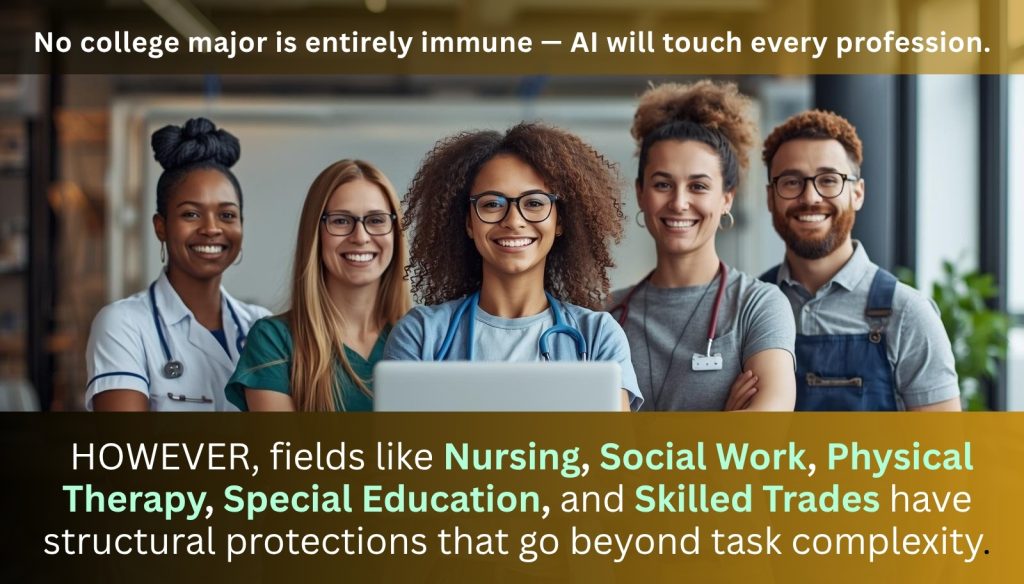
Nursing and direct patient care are most consistently cited as the most AI-resistant major paths, combining physical presence, licensed authority, emotional care, and real-time human judgment. Social work, physical therapy, special education, and skilled trades follow closely. No major is entirely immune — AI will touch every profession — but these fields have structural protections that go beyond task complexity.
Will AI eventually replace all white-collar jobs?
The most credible labor economists and AI researchers do not project AI replacing all white-collar jobs. AI is more likely to restructure professions — automating certain tasks within jobs, changing the skills valued within fields, and shifting where human judgment is most needed — than to eliminate professions in their entirety. The historical pattern from previous technological transitions (industrialization, computerization) points to occupational transformation, not mass permanent unemployment, though the pace and distribution of disruption vary significantly.
Is it a mistake to major in computer science because of AI?
No. Computer science and software engineering remain excellent degree choices — but the nature of valuable expertise within these fields is shifting. Students who develop deep expertise in AI systems, machine learning engineering, software architecture, and human-computer interaction are better positioned than those who learn to write routine code. The “learn to code” path to employment is more competitive; the “learn to build systems that use AI” path remains highly promising.
What should I double major in to make my degree more AI-resistant?
Pairing a technical major with a human-centered one creates powerful combinations. Effective pairings include: Computer Science + Psychology or Philosophy (for human-computer interaction and AI ethics), Biology + Data Science (for biomedical research), Business + Sociology or Organizational Behavior (for leadership and management roles), Law + Ethics or Technology Policy, Education + Cognitive Science or Special Education.
Does a graduate degree make you more AI-resistant?
Graduate degrees in fields that require professional licensure (medicine, law, clinical social work, and physical therapy) carry significant structural protection because licensure is tied to a human practitioner. Graduate degrees in fields undergoing AI transformation (finance, certain engineering specializations) provide less inherent protection unless paired with skills in AI system management, ethics, or human-centered specialization.
Is it worth majoring in art if AI can generate images?
Yes — with the right perspective. AI image generation is a genuine disruption to certain segments of the commercial art market. However, fine arts education cultivates something AI cannot generate: an original artistic voice rooted in a specific human life and creative vision. Fine arts graduates who build distinctive creative identities, engage meaningfully with the role of AI in contemporary culture, and develop entrepreneurial approaches to their practice remain valuable. Art is not primarily a content production industry — it is a human meaning-making practice.
What are the fastest-growing AI-resistant careers through 2035?
Based on Bureau of Labor Statistics projections and labor economics research, the fastest-growing AI-resistant career paths through 2035 include: registered nurses and nurse practitioners, physical and occupational therapists, social workers and case managers, construction managers and skilled trades, environmental scientists and sustainability managers, special education teachers, mental health counselors, and surgical and medical technologists.
Final Thoughts
The students most likely to thrive over the next decade are not those who found the perfect AI-proof hiding spot in a niche major. They are the students who developed genuine human depth — wisdom, relational skill, creative originality, ethical reasoning — alongside thoughtful AI fluency.
AI will be a powerful tool available to virtually every profession. The question is not whether you will use it, but whether you have the human foundation that makes your use of it meaningful, trustworthy, and irreplaceable.
Choose a major that cultivates who you are as a thinking, caring, creative human being. Then learn to use AI the way a surgeon uses a scalpel: as a precision instrument in service of fundamentally human work.